How to Scale a Coaching Program in 5 Steps

Kara Leanne
Scalable Coaching Systems Expert · Updated September 11, 2026
Scalable Coaching Systems builds affordable, done-for-you lead generation and funnel systems for online coaches — because scaling starts with a backend that captures and converts leads automatically.
Get a Free Funnel Strategy →Scaling a coaching program means serving more clients without relying only on more one-to-one hours. The goal is to protect the quality of the client experience while improving delivery, operations, sales, and measurement. This guide explains how to scale a coaching program in five practical steps, using clear systems instead of guesswork.
Step 1: What does "scale" mean for your coaching program?
Scaling a coaching program means increasing capacity, revenue potential, or impact without increasing your workload at the same rate. It is not just about getting more clients. It is about designing a program that can be delivered consistently, supported efficiently, and improved over time.
Before changing your offer, define what kind of scale you want. A solo coach may want fewer custom calls and more structured group delivery. A coaching company may want to train additional coaches, standardize client onboarding, or expand into new markets. The right path depends on your current model, your clients, and the outcomes you help them achieve.
Start with a clear picture of what is working now. Look at your strongest client results, your most common delivery challenges, and the activities that take the most time. This helps you avoid scaling complexity.
Clarify the current state
Use this checklist before building anything new:
- Identify your core coaching promise in one sentence.
- List the client problems your program solves most consistently.
- Note which parts of delivery require your personal attention.
- Review which client questions come up repeatedly.
- Identify where clients get stuck, delayed, or confused.
- Estimate how many clients you can serve well today.
- Decide what quality should never be compromised.
This step matters because a vague offer is hard to scale. If every client receives a fully custom experience, growth usually creates stress. If the core journey is clear, you can build structure around it.
Choose a scaling goal
A coaching program can scale in several ways. You may want to increase enrollment, reduce delivery time, improve client completion, add group formats, license your method, or train a team. Each goal requires different systems.
For example, if your goal is to serve more clients with the same team, you may need better curriculum, group coaching, templates, and community support. If your goal is to maintain a premium one-to-one model, you may focus on better qualification, pricing structure, and operational support instead.
Step 1 checklist
- Define what scale means for your business.
- Choose one primary scaling goal for the next phase.
- Document your current client journey from first contact to completion.
- Identify delivery bottlenecks.
- Protect the elements that create strong client outcomes.
Step 2: Turn your coaching method into a repeatable framework
A repeatable framework is the foundation of a scalable coaching program. It turns your knowledge into a clear path clients can follow, even when every client has different details. This does not remove personalization. It gives personalization a structure.
Think of your framework as the map behind your coaching. It should show the stages clients move through, the decisions they need to make, the skills they need to build, and the results they should reach at each point. When this is clear, you can create lessons, worksheets, exercises, and checkpoints that support the journey.
A strong framework also helps your sales and marketing. People are more likely to understand your program when they can see how it works. This is especially important if you want to position your offer as the best business coaching program to scale a company for a specific audience. That claim must be supported by a clear method, not broad language.
Map the client transformation
Begin with the end result and work backward. What should a client understand, decide, implement, or change by the end of the program? Then break that transformation into stages.
A simple structure may include:
- Starting point: what the client is experiencing before the program.
- Milestone one: the first shift they need to make.
- Milestone two: the system, habit, or strategy they need to build.
- Milestone three: the implementation stage.
- Final outcome: the result they are working toward.
This map keeps the program focused. It also makes it easier to notice when extra material is helpful and when it is just adding noise.
Build reusable assets
Reusable assets reduce repetition and improve consistency. They also help clients take action between coaching sessions. These assets can be simple, especially at first.
Useful assets include:
- Program roadmap or timeline.
- Lesson outlines.
- Worksheets and reflection prompts.
- Implementation checklists.
- Email templates.
- Onboarding forms.
- Progress trackers.
- Call agendas.
- Decision guides.
The purpose is not to create a large content library. The purpose is to answer common needs in a consistent way. If clients often ask the same question, create a resource. If they often skip a key step, create a checklist. If they struggle to prepare for sessions, create a short pre-call form.
Step 2 checklist
- Write the main client transformation in plain language.
- Break the journey into clear stages.
- Create milestones for each stage.
- Build simple resources for repeated questions or tasks.
- Remove content that does not support the main outcome.
- Test the framework with real clients before expanding it.
Step 3: Design delivery so it does not depend on constant live access
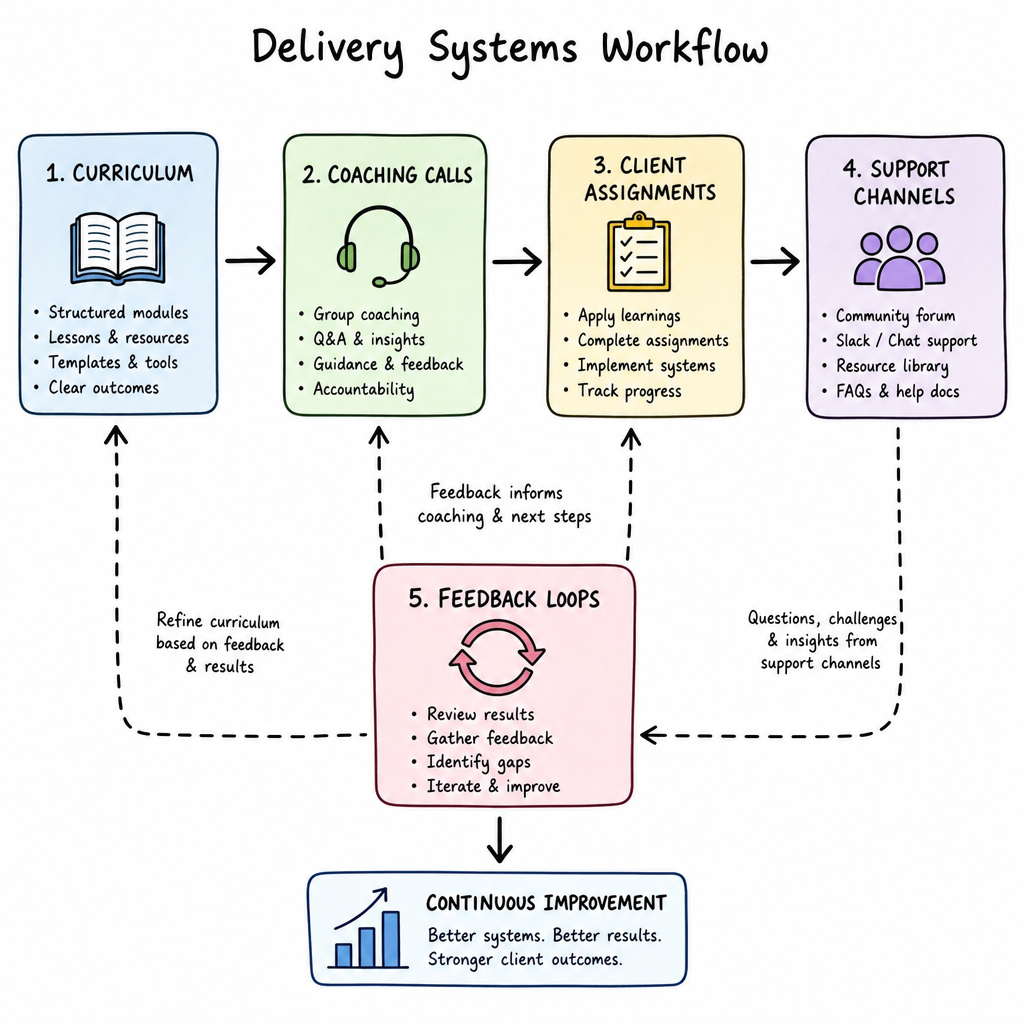
To scale a coaching program, you need a delivery model that balances support with efficiency. Live coaching is valuable, but a program that depends entirely on live access can become hard to grow. The solution is to decide what should happen live, what can be self-guided, and what can be supported through systems.
A scalable delivery model often includes a mix of live coaching, recorded content, templates, group discussion, asynchronous feedback, and community support. The exact mix depends on the program promise and client needs. The key is to use each format for the right purpose.
Match the format to the task
Live coaching is best for judgment, discussion, accountability, and problem solving. Self-guided materials are useful for teaching repeatable concepts. Templates and tools help clients implement faster. Group formats allow clients to learn from shared examples. Written or recorded feedback can reduce meeting load while still giving clients direction.
This division helps protect your energy and your clients' results. Clients should not need a live call for every small question. At the same time, they should not feel abandoned with only videos and worksheets.
Standardize onboarding and support
Onboarding is one of the easiest places to improve scale. A clear onboarding process helps clients understand what to expect, where to find resources, how to ask for help, and what they should do first. It also reduces confusion for your team.
A simple onboarding sequence may include:
- Welcome message.
- Program overview.
- Access instructions.
- First assignment.
- Coaching schedule.
- Communication guidelines.
- Support boundaries.
- Success expectations.
Support boundaries are especially important. Clients should know which questions belong in a call, which belong in a support channel, and what response times to expect. Clear boundaries create a better experience for everyone.
Step 3 checklist
- Decide which parts of the program require live coaching.
- Move repeatable teaching into reusable lessons or guides.
- Create a standard onboarding process.
- Set clear communication and response guidelines.
- Use templates for common client tasks.
- Build a system for tracking client progress.
- Review whether clients can move forward between live sessions.
Step 4: Build a scalable client acquisition system
A scalable program needs a reliable way to attract and enroll the right clients. Without this, the delivery system may be strong, but enrollment will remain unpredictable. Client acquisition should be clear, repeatable, and aligned with the program's capacity.
This step is not about using every marketing channel. It is about choosing a simple path from awareness to enrollment. The path should help potential clients understand the problem, trust the method, and decide whether the program fits their needs.
Define the right-fit client
Scaling becomes harder when the program accepts clients with very different needs. A wide audience may seem appealing, but it often leads to custom delivery, unclear messaging, and lower completion. A focused audience makes the program easier to explain and improve.
Clarify who the program is for by answering:
- What problem are they trying to solve?
- What have they already tried?
- What level of readiness do they need?
- What resources, time, or commitment must they bring?
- Who is not a good fit?
This does not mean you can only serve one narrow group forever. It means each version of the program should have a clear fit.
Create a simple enrollment path
A scalable acquisition system usually includes a few core pieces. These may be content, referrals, webinars, discovery calls, email sequences, partnerships, or direct outreach. The best choice depends on your audience and sales process.
For many coaching programs, a simple path looks like this:
- A potential client discovers useful content.
- They learn the program's point of view.
- They see the framework and expected journey.
- They complete an application or book a call.
- They receive clear next steps.
Keep this path easy to understand. If a potential client cannot tell what the program does, who it is for, or how to take the next step, the acquisition system needs work. If you'd rather have the whole path — capture, nurture, qualification, and booking — built for you, see our done-for-you sales funnels for online coaches and our done-for-you lead generation system.
Align marketing with delivery capacity
Growth should match your ability to serve clients well. If you enroll too many clients before your delivery systems are ready, quality can suffer. If your systems are ready but your messaging is unclear, growth may stall.
Review your capacity before each enrollment push. Consider how many clients you can support, how many calls are required, what team support is available, and which parts of the program may create bottlenecks.
Step 4 checklist
- Define the right-fit client clearly.
- Write a plain-language program promise.
- Choose one or two primary acquisition channels.
- Create a clear enrollment process.
- Use qualification questions to protect program fit.
- Make next steps visible and simple.
- Match enrollment goals to delivery capacity.
Step 5: How will you measure and improve the program?
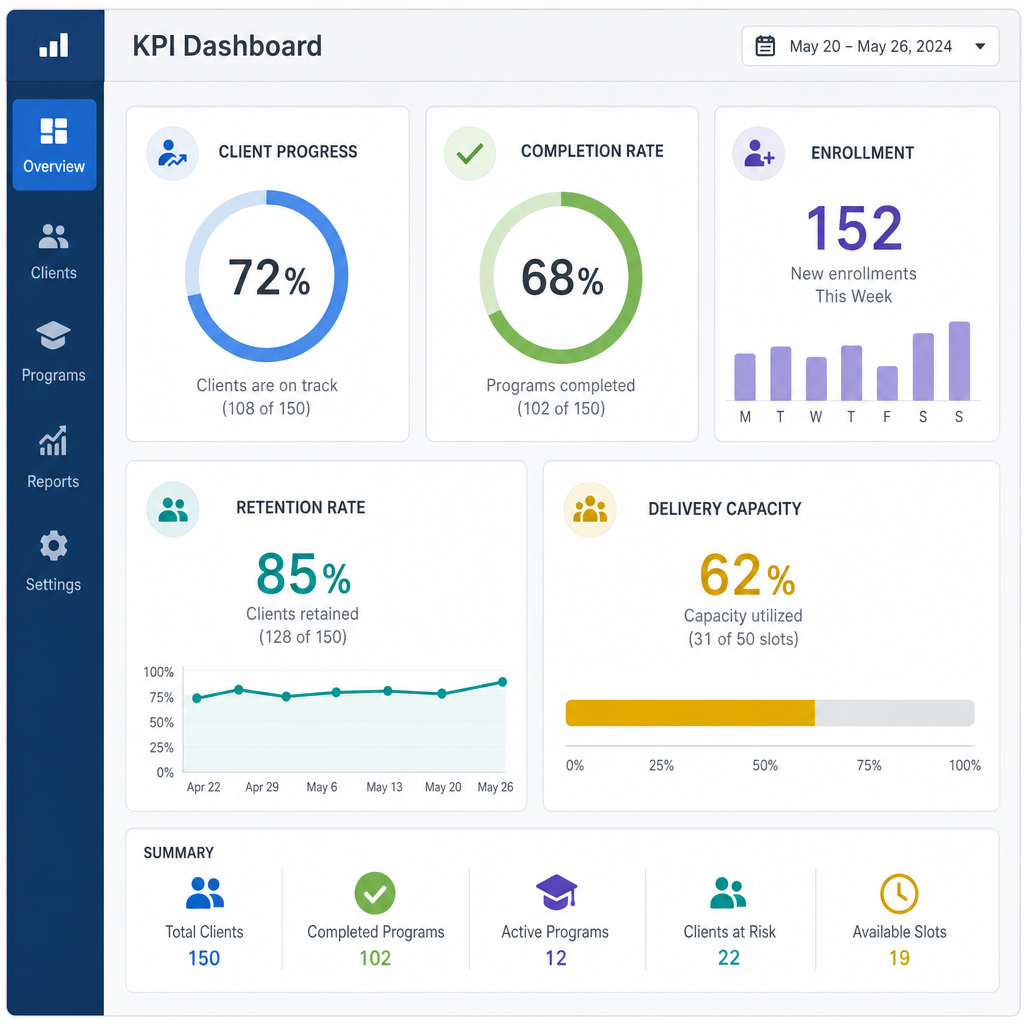
You measure and improve a coaching program by tracking both business performance and client progress. Scaling without measurement can hide problems until they become expensive or difficult to fix. A simple scorecard helps you see what is working, what needs attention, and where the next improvement should happen.
Measurement does not need to be complex. Start with a small set of useful indicators. Review them on a regular schedule, and connect each number to a practical decision.
Track client progress
Client outcomes are central to a coaching program. If clients are not moving through the journey, more growth will not solve the problem. Track progress at key points so you can see where support is needed.
Useful client progress signals include:
- Onboarding completion.
- Attendance or participation.
- Assignment completion.
- Milestone achievement.
- Client feedback.
- Common questions or blockers.
- Completion of the full program journey.
These signals help you improve the experience. For example, if many clients fail to complete the first assignment, the assignment may be unclear, too large, or poorly timed. If many clients ask the same question after a lesson, the lesson may need a better example.
Track business performance
Business metrics show whether the program can grow in a healthy way. They also help you decide when to adjust pricing, hiring, marketing, or delivery.
Useful business signals include:
- Number of qualified leads.
- Conversion from call or application to enrollment.
- Client capacity by coach or cohort.
- Time spent on delivery.
- Support requests per client.
- Renewal, continuation, or referral patterns.
- Revenue by program format.
Avoid tracking too many numbers at once. A small scorecard that you actually review is more useful than a complex dashboard that no one uses.
Improve one constraint at a time
Once you have data, look for the biggest constraint. It may be acquisition, onboarding, delivery, client completion, team training, or retention. Choose one area, make a change, and observe the result.
This is how you scale a coaching program without constantly rebuilding it. You create a stable model, test improvements, and keep what works. Over time, the program becomes easier to explain, easier to deliver, and easier to manage.
Step 5 checklist
- Choose a few client progress indicators.
- Choose a few business performance indicators.
- Review the scorecard on a regular schedule.
- Collect client feedback at key milestones.
- Identify one main bottleneck at a time.
- Make small improvements before major redesigns.
- Document changes so the team can repeat what works.
Bringing the five steps together
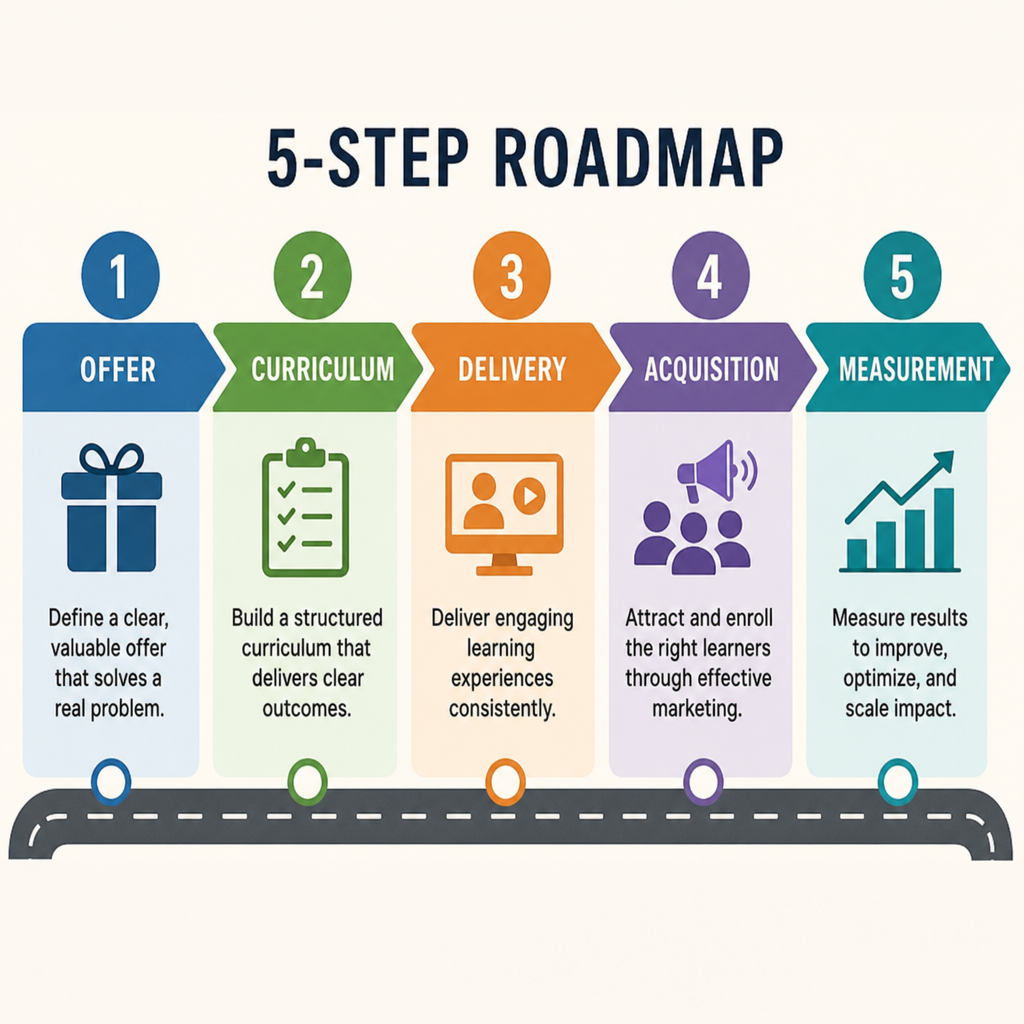
Scaling a coaching program is a structured process. First, define what scale means for your model. Then turn your method into a repeatable framework, design delivery systems, build a clear acquisition path, and measure what matters.
The strongest programs usually grow from clarity, not complexity. They make the client journey easier to understand, the delivery process easier to manage, and the improvement process easier to repeat. This is what allows a coaching business to grow without losing the quality that made the offer valuable in the first place.
If you are ready to take the next step, review your current coaching program against the five checklists above. Choose the one area creating the biggest bottleneck, document it clearly, and improve that part before adding more clients.
Frequently Asked Questions
Quick answers to the most common questions about this topic.
Ready to Scale Your Coaching Program?
Get a customized blueprint for systemizing your coaching delivery, onboarding, and client growth.
Where should we send it?
Scaling starts with a backend that captures, follows up with, and converts leads automatically. Get the system built around your coaching business. done-for-you lead generation and funnel systems.
Related Articles
How To Scale Your Coaching Business Without Burning Out
Scaling a coaching business should increase your impact and income, not stretch your calendar until there is nothing left of you. Here is how to grow sustainably.
ScalingHow to Systemize Your Coaching Business Before You Scale
A coaching business is easier to grow when daily work is clear, repeatable, and not dependent on memory. Learn essential systems for lead intake, onboarding, session delivery, and scaling operations.
ScalingHow to Know When Your Coaching Business Is Ready to Scale
Adding more leads, clients, and revenue to a business that already feels difficult to manage doesn't solve anything — it can make the existing problems bigger. Here's how to know if your business is actually ready to scale.