Sales Funnel for Coaches: What You Actually Need

Kara Leanne
Scalable Coaching Systems Expert · Updated June 16, 2026
A strong coaching funnel helps the right people discover your expertise, understand your offer, and take the next step without feeling pressured. Instead of relying on random posts, referrals, or occasional discovery calls, you create a clear path from first impression to booked client. This guide walks you through the practical steps to build a sales funnel for coaches, especially if you sell online coaching, group programs, workshops, or one-to-one packages.
What should a sales funnel for coaches actually do?
A sales funnel for coaches should turn attention into trust, and trust into a clear buying decision. At the top, it attracts people with a specific problem your coaching can help solve. In the middle, it gives them useful guidance, shows your approach, and helps them believe change is possible. At the bottom, it invites qualified prospects to book a call, join a program, or purchase a coaching offer.
The best online coaching funnels are not complicated. They are focused. Your funnel should answer four questions for the prospect: “Do you understand my problem?”, “Can you help someone like me?”, “What happens if I work with you?”, and “What should I do next?” When every step answers one of those questions, your marketing feels helpful instead of pushy.
1. Define the coaching outcome you want to sell
Before you build pages, emails, ads, or lead magnets, choose the coaching outcome your funnel will support. A vague offer creates a vague funnel. If your offer is “life coaching,” “business coaching,” or “wellness coaching,” prospects may struggle to understand why they should act now. If your offer is tied to a specific outcome, the entire funnel becomes easier to write and easier to sell.
Start by naming the transformation in plain language. For example, your offer might help clients create a calmer morning routine, prepare for career change, improve leadership confidence, build a content system, or recover consistency with fitness habits. The goal is not to promise unrealistic results. The goal is to make the direction clear enough that the right person can recognize themselves.
Clarify these core elements:
- Audience: Who is the offer for, and what stage are they in?
- Problem: What specific struggle are they trying to solve?
- Desired outcome: What do they want to feel, do, build, or change?
- Format: Is the offer one-to-one coaching, group coaching, a workshop, a course with support, or a hybrid?
- Next action: Should the prospect book a call, apply, register, or buy directly?
This first decision affects every later step. A funnel for a high-touch executive coaching package may invite people to apply for a private call. A funnel for a lower-ticket online workshop may lead directly to checkout. A funnel for a group coaching program may nurture prospects until enrollment opens. Match the funnel to how much trust and conversation the sale requires.
2. Map the customer journey before choosing tools
Many coaches start with software too early. They compare landing page builders, email platforms, schedulers, and webinar tools before they know what the funnel needs to say. Tools matter, but they should support the journey rather than define it.
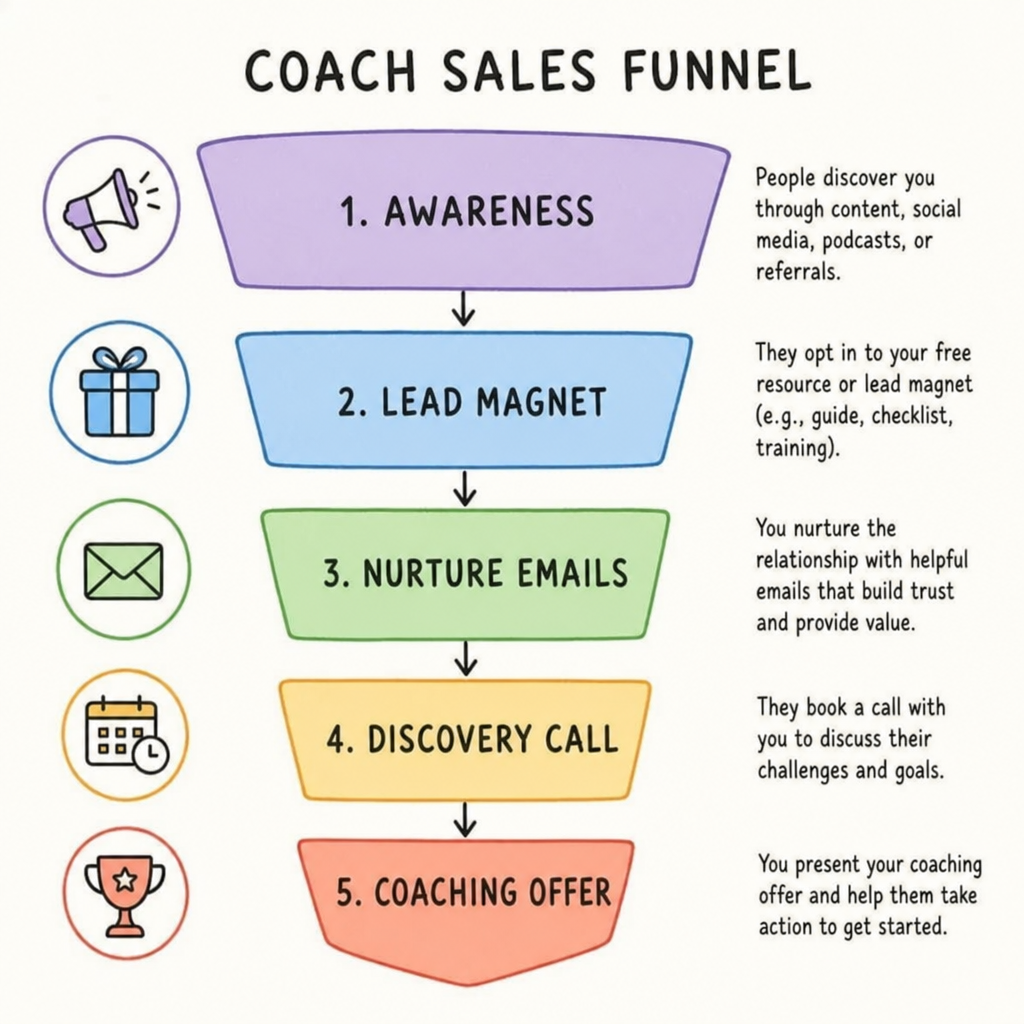
Map your funnel as a simple path. A typical sales funnel coaching journey might look like this:
- A potential client finds your content through search, social media, referral, podcast, or paid promotion.
- They visit a landing page that speaks to one problem.
- They exchange their email address for a useful resource or training.
- They receive a short nurture sequence that builds trust and frames the problem.
- They are invited to take the next step, such as booking a discovery call or joining a program.
- They receive follow-up communication if they do not act immediately.
At each stage, write down what the prospect is thinking. At awareness, they may only know they feel stuck. During nurture, they may compare options or worry coaching will not work for them. Near the decision point, they may need clarity on fit, process, time commitment, or support.
This journey map keeps your funnel human. You are not pushing strangers through an automation. You are guiding real people from uncertainty toward a confident next step.
3. Choose one traffic source to start
A funnel needs traffic, but it does not need every traffic channel at once. Choose one primary source you can maintain consistently. For many coaches, organic content is the most realistic starting point. Search-friendly blog posts, short-form social content, podcast appearances, LinkedIn posts, YouTube videos, or guest workshops can all bring people into a funnel.
Pick the channel based on where your audience already looks for help and where you can show up with quality. If your clients search detailed questions, SEO content can work well. If they respond to personal insight and professional credibility, LinkedIn may be better. If your coaching relies on teaching and demonstration, video or live workshops may help people experience your style before they speak with you.
Your first traffic source should meet three criteria:
- You can create content there without burning out.
- Your ideal clients already spend time there.
- The channel gives you a natural way to invite people into your lead magnet or next step.
Avoid measuring success only by likes or impressions. The better question is whether the channel attracts people who match your coaching offer. A smaller audience with clear intent can outperform a large audience that only consumes free advice.
4. Create a lead magnet that solves one immediate problem
Your lead magnet is the bridge between public content and private conversation. It should offer a quick, relevant win connected to your paid coaching outcome. The mistake many coaches make is creating a broad freebie that attracts anyone. A good lead magnet attracts the kind of person who might eventually need your paid support.
Useful lead magnets for online coaching funnels include:
- A short checklist that helps prospects diagnose their current situation.
- A guided worksheet that turns reflection into action.
- A mini-training that explains your method for solving a specific problem.
- A script, template, or planner that removes friction.
- A self-assessment that helps prospects understand what they need next.
Keep it focused. If you are a career coach, a lead magnet about “finding purpose” may be too broad. A better version might be a worksheet for identifying transferable skills before a career pivot. If you are a health coach, a general nutrition guide may attract casual browsers. A better option might be a three-day meal planning reset for busy professionals who struggle with consistency.
The lead magnet should not replace your coaching. It should help the prospect see the problem more clearly, experience your perspective, and recognize the value of deeper support.
What do you need before building the funnel pages?
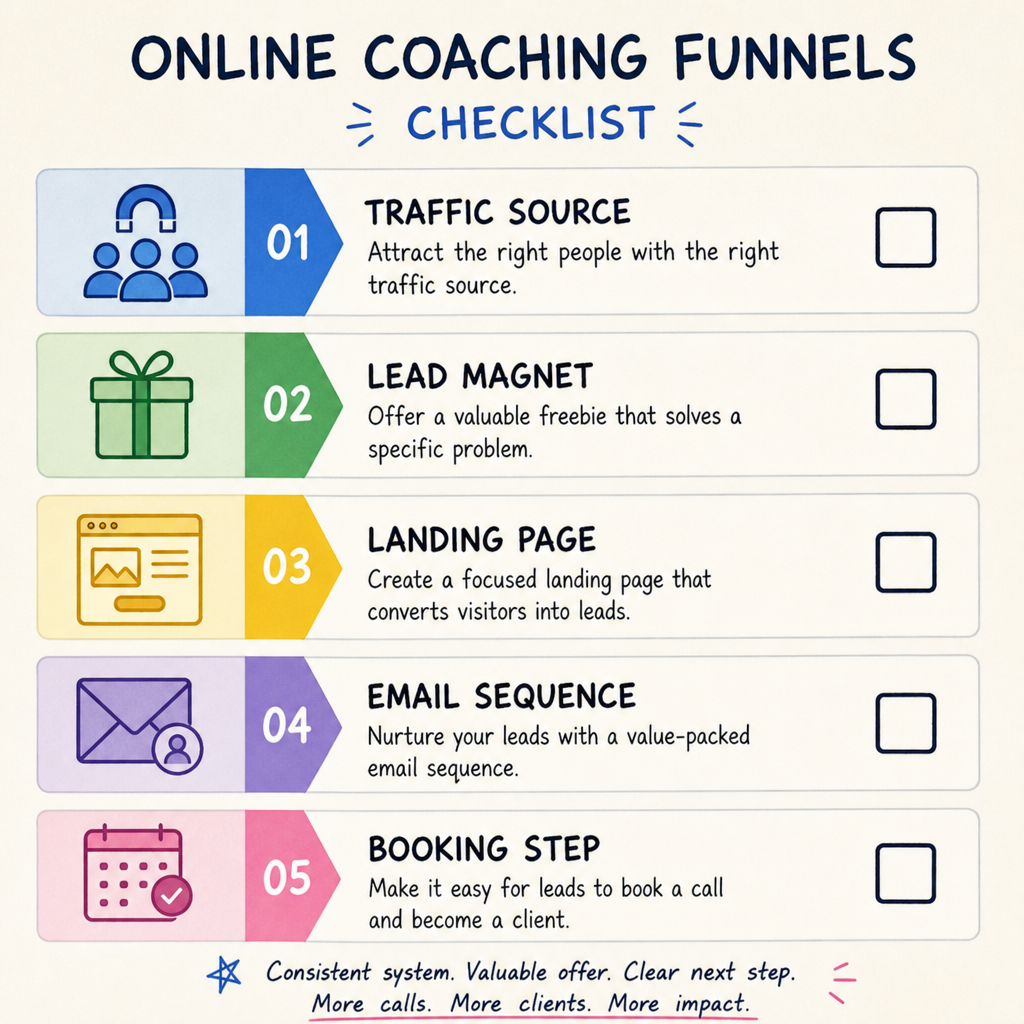
Before building pages, you need a clear offer, one ideal client profile, one lead magnet, one primary call to action, and a simple follow-up plan. You do not need a perfect brand, a large audience, or a complex automation system to begin. You do need enough clarity that each page can speak to one person, one problem, and one next step.
Gather these assets first:
- A concise description of your coaching offer.
- A short bio that explains why you are relevant to this problem.
- Three to five common pain points your audience mentions.
- Three to five outcomes your coaching helps clients work toward.
- A lead magnet file, video, quiz, or registration page.
- A booking link, application form, or checkout link.
- A basic email platform to deliver and follow up.
This preparation prevents scattered messaging. It also makes the writing process faster because you are not inventing your offer while designing the funnel.
5. Write a landing page that makes the free offer feel worth it
The landing page has one job: persuade the right visitor to opt in. It does not need to explain your entire coaching philosophy. It needs to show that the free resource is relevant, useful, and easy to consume.
Start with a headline that names the problem or desired outcome. Then explain what the visitor will get and why it matters. Use benefit-driven bullets, but keep them specific. Instead of saying “gain clarity,” explain what kind of clarity the resource provides. Instead of saying “transform your mindset,” explain the practical shift the worksheet, training, or checklist helps create.
A simple landing page structure works well:
- Headline: State the immediate result or topic of the lead magnet.
- Subheadline: Explain who it is for and when they should use it.
- Bullets: List what they will learn, complete, or identify.
- Visual: Show a mockup or simple image of the resource.
- Opt-in form: Ask only for the information you need, usually name and email.
- Trust element: Add a brief bio, short credibility note, or description of your approach.
- Call to action: Use clear button text such as “Get the checklist” or “Watch the training.”
Remove distractions. Do not send visitors to unrelated pages, social profiles, or multiple offers. A focused landing page gives prospects one decision to make, which improves the experience and makes your funnel easier to measure.
6. Build a thank-you page that moves the relationship forward
Many coaches treat the thank-you page as an afterthought. That is a missed opportunity. The thank-you page appears at a moment when the prospect has just raised their hand. They are paying attention, and they are open to guidance.
Use the thank-you page to confirm what happens next. Tell the person to check their inbox, explain how to access the resource, and set expectations for any follow-up emails. Then offer one logical next step. That might be watching a short welcome video, answering a one-question survey, booking a call, or reading a helpful article.
For a high-ticket coaching offer, you can softly introduce the discovery call here. Avoid aggressive language. A simple message works: “If this is the challenge you want support with now, you can book a conversation to explore whether coaching is a fit.” This respects the prospect’s timing while making the path visible.
You can also use the thank-you page to segment leads. Ask one question such as “What are you working on right now?” or “Which challenge best describes your situation?” Their answer can help you personalize later emails or understand which audience segments are most engaged.
7. Create a nurture email sequence that earns trust
Your email sequence is where many sales funnels for online coaches become profitable, because it gives prospects time to understand your perspective. People rarely hire a coach just because they downloaded one resource. They need to feel seen, learn something useful, and understand why your coaching is the right next step.
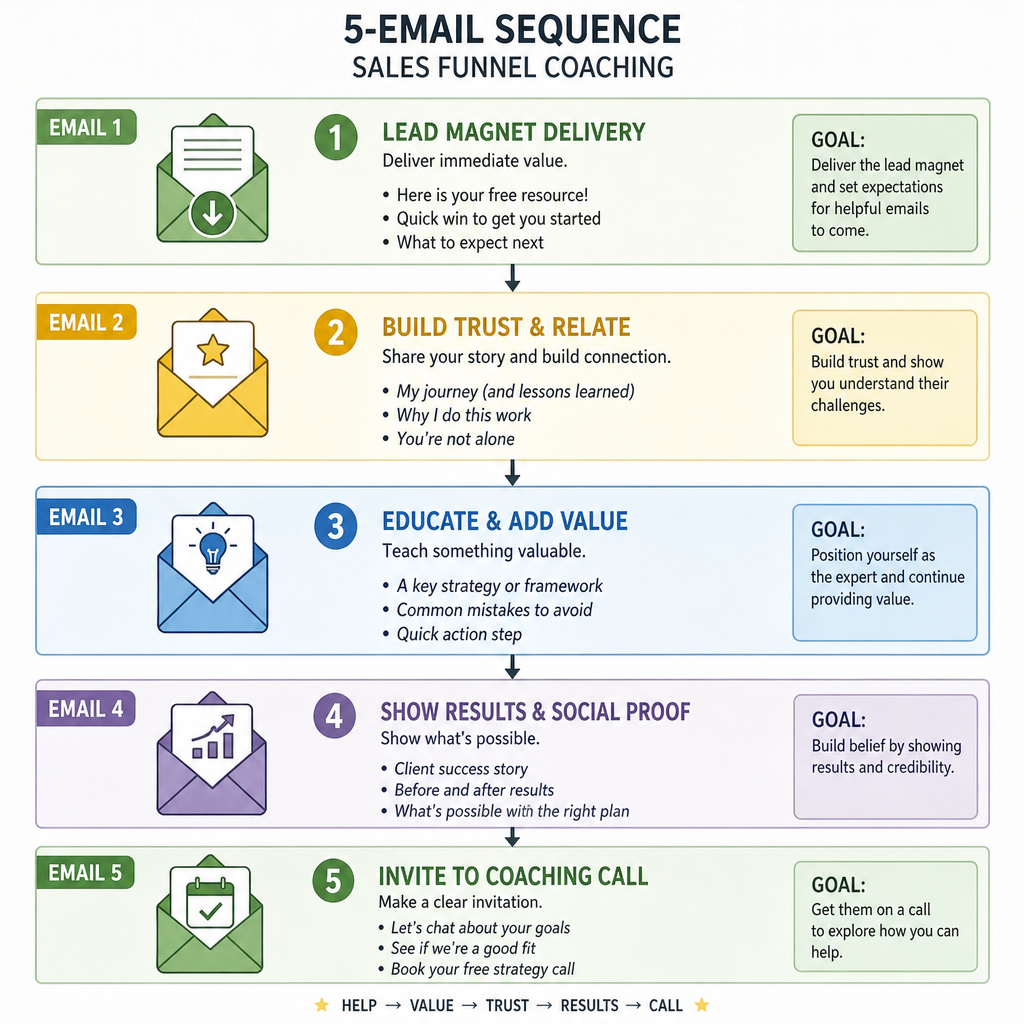
A simple five-email sequence is enough to start:
- Deliver the resource: Thank them, give the link, and remind them why it matters.
- Name the real problem: Explain the deeper issue behind the surface symptom.
- Teach a useful shift: Share a framework, prompt, or exercise they can apply.
- Address hesitation: Discuss a common objection, misconception, or fear with empathy.
- Invite action: Offer a call, application, workshop, or paid next step.
Write like a coach, not a broadcaster. Use clear teaching, reflective prompts, and direct invitations. If your emails feel like mini coaching moments, prospects begin to understand what working with you might be like.
Do not hide the offer until the final email. Mention it naturally earlier when it helps the reader connect the dots. For example, after teaching a framework, you can say that clients often use this inside your coaching process to make better decisions. The goal is not to over-promote; it is to make the paid path familiar before you invite action.
8. Design a conversion step that matches your coaching model
Your conversion step is the point where a lead becomes a serious prospect or paying client. It must match the type of coaching you sell. A high-trust service usually needs a conversation. A low-cost resource may sell through a checkout page. A group program may use a webinar, waitlist, or application.
Choose one primary conversion action:
- Discovery call: Best for one-to-one coaching, premium packages, or highly personalized support.
- Application form: Useful when you need to qualify prospects before a call.
- Webinar or workshop: Strong for teaching your method and inviting people into a group offer.
- Sales page: Works when the offer is clear, the price point is accessible, and prospects can decide without a call.
- Waitlist: Helpful when enrollment opens at specific times or when you want to build demand before launch.
Make the action clear throughout the funnel. If your goal is booked calls, your emails, thank-you page, and content should gradually prepare people for that conversation. If your goal is workshop registration, the funnel should build interest in the topic and show why attending live or watching the training is worthwhile.
The conversion page itself should explain fit. Include who the offer is for, what the process looks like, what the prospect can expect next, and what they should do if they are unsure. This reduces friction and prevents unqualified calls.
9. Write calls to action that feel specific and low-friction
A call to action should not sound like a command shouted at the reader. It should feel like the obvious next step. Generic CTAs such as “Submit” or “Learn more” often miss the chance to reinforce value. Specific CTAs help the prospect understand what they will receive.
Use action language tied to the stage of the funnel:
- For a lead magnet: “Get the planning worksheet” or “Download the coaching checklist.”
- For a webinar: “Save my seat” or “Register for the free training.”
- For a discovery call: “Book a fit call” or “Apply for coaching.”
- For a waitlist: “Join the program waitlist.”
- For a paid offer: “Start the coaching process.”
Support each CTA with a short line of reassurance. Tell people what happens after they click. For example, “You’ll choose a time, answer a few fit questions, and receive a confirmation by email.” Small details reduce uncertainty, especially for prospects who are interested but cautious.
Place CTAs where they naturally follow value. On a landing page, repeat the CTA after the main benefits and near the bottom. In emails, include one clear CTA instead of several competing links. In content, invite readers into the lead magnet after you have helped them understand why the resource is relevant.
How do you know whether your coaching funnel is working?
You know your coaching funnel is working when the right people enter it, engage with the content, and take the intended next step. Do not judge the funnel only by total subscribers. A smaller list that books qualified calls is more valuable than a large list that never responds.
Track a few practical signals:
- How many visitors reach the landing page.
- How many people opt in for the lead magnet.
- How many open, click, or reply to nurture emails.
- How many book calls, apply, register, or buy.
- How many booked prospects are actually a fit for your coaching.
- Which traffic source produces the strongest leads.
Review these numbers in context. If traffic is low, the funnel may not have enough visibility. If opt-ins are low, the lead magnet or landing page message may be unclear. If email engagement is weak, the sequence may need stronger relevance or a better subject line. If calls are booked but few are qualified, your messaging may be attracting the wrong audience.
Use measurement to improve one step at a time. Changing everything at once makes it hard to know what worked. Adjust the headline, lead magnet promise, email invitation, or call booking page individually so you can learn from each test.
10. Add trust without overloading the funnel
Trust matters in coaching because prospects are considering a personal investment of time, money, and attention. They want to know whether you understand their situation and whether your support feels credible. Still, trust-building should be relevant, not excessive.
Add trust elements where they help the decision:
- A short coach bio that connects your experience to the audience’s problem.
- A clear explanation of your coaching approach or framework.
- Client testimonials, if you have permission to use them.
- Case examples, only when accurate and approved.
- Screenshots or previews of worksheets, modules, or support materials.
- Answers to common concerns about fit, format, or expectations.
If you do not have testimonials yet, do not invent social proof. Instead, build trust through clarity. Explain your process, show your thinking, and give useful guidance before asking for a commitment. Prospects can sense when a funnel is inflated with vague claims. Honest specificity is stronger than exaggerated proof.
11. Connect your content to the funnel consistently
A funnel does not work if nobody enters it. Once the core pieces are built, connect your regular content to the lead magnet or conversion step. This is where SEO and content strategy support sales funnel coaching in a practical way.
Create content around the problems your ideal clients search, discuss, or quietly struggle with. A business coach might publish posts about pricing, client acquisition, or decision fatigue. A relationship coach might create content about communication patterns, boundaries, or rebuilding trust. A leadership coach might discuss delegation, confidence, difficult conversations, or team alignment.
Each content piece should have one relevant next step. If an article teaches a topic related to your lead magnet, invite readers to download it. If a video explains a common mistake, point viewers to a worksheet that helps them fix it. If a podcast episode explores readiness for coaching, invite listeners to apply or book a fit call.
This consistency turns your marketing into an ecosystem. Your public content starts the conversation, your lead magnet continues it, your emails deepen it, and your offer gives prospects a way to get support.
12. Automate the simple parts and keep the human parts personal
Automation is useful, but coaching is still relational. Automate repetitive tasks so you can spend more energy on real conversations. Your email delivery, welcome sequence, booking confirmations, reminders, and basic tagging can run in the background. Your voice, insight, and follow-up should still feel personal.
A simple tech stack may include:
- A landing page or website builder.
- An email marketing platform.
- A form or quiz tool, if needed.
- A scheduling tool for discovery calls.
- A payment or checkout tool for direct purchases.
- Basic analytics to review traffic and conversions.
Keep the system lean at first. Too much technology creates maintenance work before the funnel has proven itself. Build the simplest version that lets someone discover you, opt in, receive value, and take the next step. Once that path works, you can add segmentation, retargeting, webinars, or more advanced automations.
Personal touches make a difference. Invite replies to your emails. Ask a thoughtful question on the application form. Send a short pre-call note when appropriate. These moments remind prospects that there is a real coach behind the funnel.
13. Improve the funnel with small, regular reviews
Your first funnel is a working draft. Expect to refine it as you learn what your audience responds to. Set a monthly review rhythm so improvement becomes manageable rather than overwhelming.
During each review, look for one bottleneck. If people are visiting but not opting in, improve the landing page promise or make the lead magnet more specific. If people download but never click emails, rewrite the sequence around stronger pain points and clearer teaching. If prospects book calls but do not buy, review whether the funnel prepared them for the offer, price range, format, and expected commitment.
You can also improve by listening to language. Pay attention to the words prospects use on calls, in replies, in comments, and in intake forms. Those phrases often make better headlines and email topics than polished marketing language. A strong sales funnel for coaches sounds like the client’s real world, not a template.
Make changes gradually. One clear improvement each month can compound into a funnel that feels sharper, more aligned, and easier to trust.
A practical coaching funnel checklist
Use this checklist to build or audit your funnel from top to bottom:
- You have one clearly defined coaching offer.
- Your ideal client and core problem are specific.
- Your lead magnet offers one useful, relevant win.
- Your landing page has one message and one opt-in action.
- Your thank-you page confirms delivery and offers a logical next step.
- Your nurture emails teach, reassure, and invite action.
- Your conversion step matches the offer and level of trust required.
- Your calls to action are specific and easy to understand.
- Your content points people toward the funnel regularly.
- Your tracking shows where prospects enter, engage, and convert.
- Your follow-up feels human, not mechanical.
- Your funnel is reviewed and improved on a regular schedule.
If you are starting from scratch, do not try to perfect every item before launching. Build the minimum clear version, send real traffic to it, and improve based on behavior. A simple funnel that is live will teach you more than a complex funnel that never launches.
Bring your coaching funnel to life
Building a sales funnel for coaches is not about manipulating people into a decision. It is about creating a guided path for prospects who already need help and want to understand whether you are the right coach for them. When your message, lead magnet, emails, and conversion step all point to the same outcome, your marketing becomes easier to follow and easier to trust.
Start with one offer, one audience, one lead magnet, and one next step. Then write the pages, create the emails, connect your content, and review the results. Over time, your online coaching funnels can become a steady system for attracting better-fit prospects, starting better conversations, and helping more clients say yes with confidence.
Frequently Asked Questions
Quick answers to the most common questions about this topic.
Get a complete sales funnel — lead capture, nurture, qualification, and booking — built around your coaching offer so your traffic actually converts. done-for-you sales funnel built for coaches.
Related Articles
How to Build a Sales Funnel for Your Coaching Business
Learn how to build a sales funnel for coaches that attracts qualified leads, nurtures trust, and turns prospects into clients with practical online coaching funnels and sales funnel coaching steps.
Sales FunnelsHow to Find the Leaks in Your Coaching Funnel
Your funnel can lose people at almost any point — and each leak is a different problem with a different solution. Here's how to look at the entire journey and find where your traffic is actually going.
Sales Funnels9 Sales Funnel Mistakes Online Coaches Make
Most online coaches do not need a more complicated funnel. They need a clearer path that turns the right strangers into warm leads, then into qualified calls or clients. Discover the 9 biggest sales funnel mistakes to avoid.