
Effective landing pages turn focused attention into measurable action. Whether you want form submissions, demo requests, trial signups, newsletter subscribers, or quote inquiries, the page must remove distraction and make the next step feel obvious.
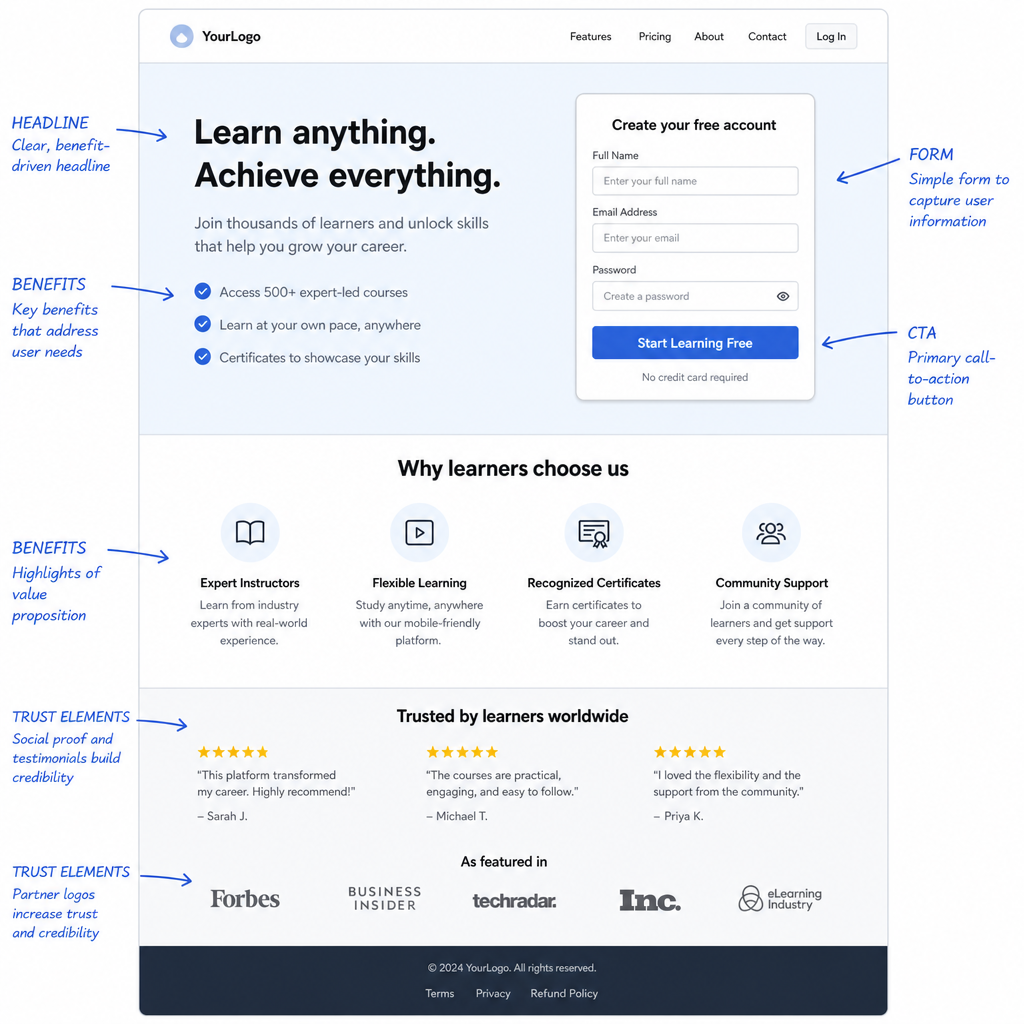
What makes effective landing pages convert?
Effective landing pages convert because every element supports one specific goal. The copy, offer, form, visual hierarchy, and call to action all work together to answer three visitor questions quickly: "Am I in the right place?", "Is this worth my time?", and "What do I do next?"
When building custom sales funnels for coaches, we use these elements as a practical checklist for planning, auditing, and optimizing conversion rates.
1. A single, specific conversion goal
A landing page should not try to do everything. Before writing copy or choosing visuals, define the one action the page exists to generate — booking a consultation, downloading a guide, starting a free trial, joining a webinar, or requesting pricing. That focus shapes every decision. If the goal is lead generation, the page should prioritize the offer, form, credibility, and follow-up expectation instead of sending visitors to unrelated pages. Multiple competing actions dilute intent and make the visitor pause, which is one of the most common reasons a high-traffic landing page still converts poorly.
2. A headline that matches visitor intent
The headline is often the first meaningful message a visitor reads, so it must confirm relevance immediately. It should connect the traffic source — search intent, ad promise, email subject line, or campaign message — to the offer on the page. A mismatch between the ad someone clicked and the headline they land on is a leading cause of bounce rate. When the headline mirrors the visitor's reason for arriving, it signals "you're in the right place" and earns the next few seconds of attention.
3. A supporting subheadline that adds context
The subheadline gives the headline room to breathe. It should expand on the main promise, clarify who the offer is for, or explain what the visitor actually receives. Think of it as the bridge between attention and interest: the headline hooks the reader, and the subheadline confirms the value is relevant to their situation. A strong subheadline also helps search engines and ad platforms understand the page's focus, which supports relevance and quality scores.
4. A compelling offer with obvious value
Lead gen tactics depend heavily on the strength of the offer. A form alone is not persuasive; visitors need a reason to exchange their time, attention, or contact details. The offer should be specific, useful, and aligned with the visitor's current stage of awareness. Learn how to craft a high-performing lead magnet to boost your opt-in rates. When the perceived value outweighs the friction of giving up an email address, conversion rates climb noticeably.
5. Benefit-focused copy that stays concrete
Visitors care about what the page helps them do, avoid, improve, or understand. Translate feature lists into tangible benefits that connect with visitor motivations. Instead of "includes a 30-page PDF," write "walk away with a step-by-step plan you can use today." Concrete, outcome-driven copy builds trust faster than vague marketing language, and it helps the reader picture the result before they ever fill out the form.
6. A clean visual hierarchy
Landing page design directs attention. Headlines should stand out, CTAs should be easy to find, forms should be visually connected to the offer, and supporting details should not overpower the main action. A clear visual hierarchy guides the eye from the headline to the value to the call to action without competing elements pulling attention away. Clutter is one of the fastest ways to tank a landing page's conversion rate, even when the copy is strong.
7. A persuasive call to action
The call to action tells the visitor what to do next. Use action-oriented CTA language like "Get the checklist" or "Book my consultation" rather than a generic "Submit." The best CTAs are specific, low-pressure, and benefit-driven — they describe the outcome the visitor gets, not the action you want them to take. A small wording change here often produces a measurable lift in conversion rate.
8. A form that asks only for what you need
Forms are key conversion points. Every required field adds effort, so ask only for information that is necessary for the next step. A low-friction lead magnet may need just a name and email, while a high-ticket consultation can justify a few qualification fields. The goal is to balance lead quality with conversion volume — too many fields and you lose signups, too few and you waste time on unqualified leads.
9. Trust signals that reduce hesitation
Trust signals — such as testimonials, client logos, review snippets, and security guarantees — reduce uncertainty and risk perception. They are especially important for cold traffic and paid ads, where the visitor has no prior relationship with you. Place them near the call to action where hesitation peaks. Check out our done-for-you coaching packages to see how transparent offers eliminate friction.
10. A smooth post-conversion experience
Tell people what to expect after they convert — confirmation emails, clear delivery steps, and calendar booking flows maintain trust and keep momentum. The moment someone opts in is not the end of the landing page's job; it's the handoff into your follow-up sequence. A confusing or silent thank-you page can undo the trust you just built, while a clear next step keeps qualified leads moving toward a sale.
Frequently Asked Questions
Quick answers to the most common questions about this topic.
Ready to Build High-Converting Funnel Pages?
Stop guessing on design and copy. Get a custom done-for-you sales funnel built around how your coaching business actually sells.
Explore DFY Packages