
A sales funnel is the step-by-step path a potential customer takes from first discovering your business to making a purchase — and ideally, coming back for more. It turns scattered marketing activity into an intentional, measurable system for attracting leads and driving revenue.
What is a sales funnel?
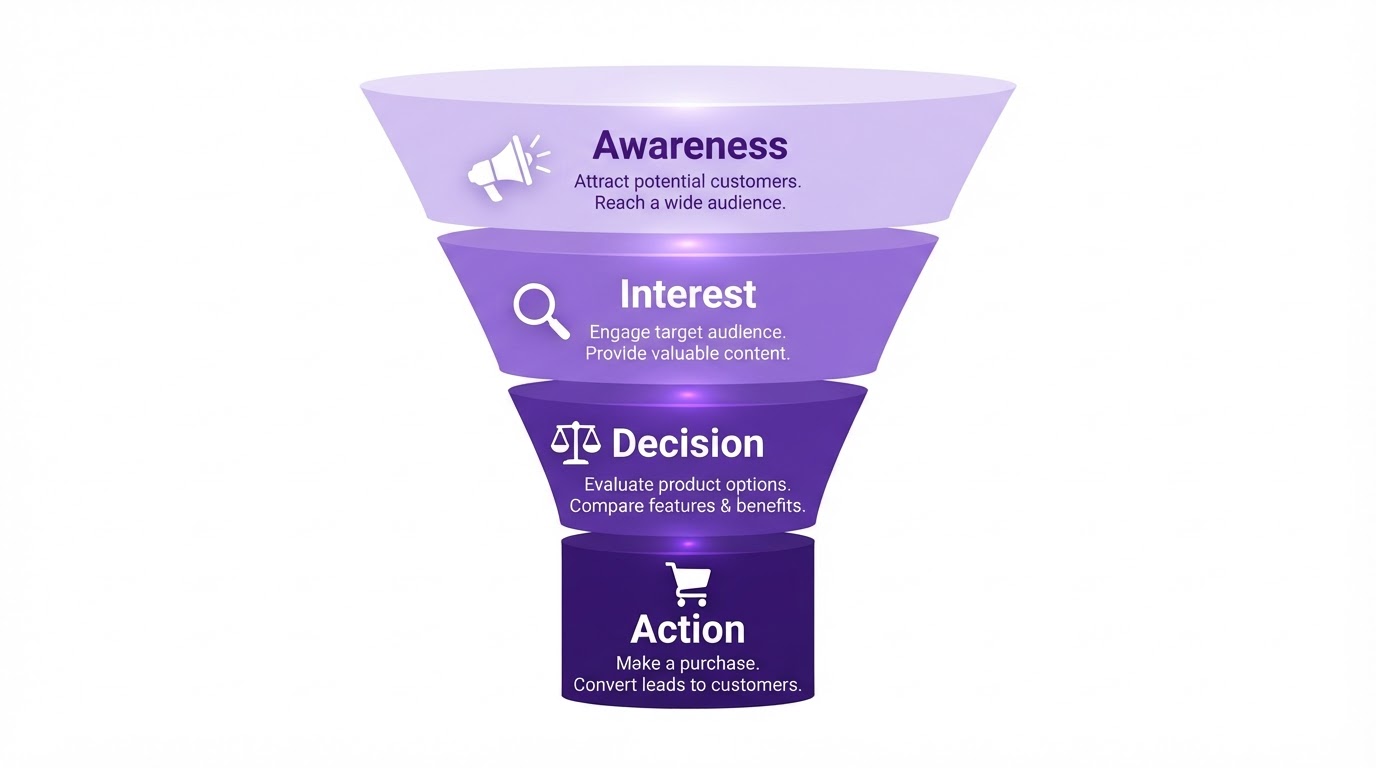
At its core, a sales funnel is a structured journey that moves people from awareness to action. Instead of asking a cold stranger to buy on the spot, a funnel matches each piece of marketing to where the buyer actually is in their decision-making process. The widest part of the funnel captures the most people; each stage narrows as prospects self-select, qualify, and move closer to a purchase.
The term "funnel" is deliberate: more people enter at the top than convert at the bottom. That drop-off is normal — and it's exactly what makes a funnel useful. By tracking how many people move from one stage to the next, you can pinpoint exactly where you're losing potential customers and fix that specific gap instead of guessing.
If you want to see how we build connected backend workflows for online coaches, check out our business automation services overview.
The 4 sales funnel stages explained
Most sales funnel models break the journey into four stages. Each stage has a different goal, a different message, and a different metric to watch.
- Awareness: The prospect discovers you exist — through search, social media, ads, a podcast, or a referral. The goal here is reach and relevance, not a sale. You're answering the question "what is this and why should I care?"
- Interest: The prospect engages further — downloading a guide, joining your email list, watching a video, or reading a case study. They're evaluating whether your solution fits their problem.
- Decision: The prospect is comparing options, reviewing pricing, reading testimonials, and weighing guarantees. This is where trust and clarity matter most. A confused buyer doesn't buy.
- Action & Retention: The prospect becomes a customer — booking a call, checking out, or signing up. Retention keeps them engaged so they renew, refer, and buy again.
How does a sales funnel work in practice?
A working funnel connects several core assets into one continuous path: a traffic source (search, ads, social, email), a landing page with a clear offer, a lead capture mechanism (a form or booking calendar), and a follow-up sequence that nurtures leads until they're ready to buy. Each handoff should feel seamless to the prospect — if someone has to think about what to do next, the funnel is leaking.
For example, a coach runs Instagram content that drives followers to a free training. The training page captures their email, an automated sequence delivers value over five days, and qualified leads are invited to book a strategy call. Every step has one job, and every step hands off cleanly to the next. Read our step-by-step guide on how to automate your coaching business for deeper implementation steps.
Sales funnel vs. marketing funnel: what's the difference?
People often use the terms interchangeably, but there's a useful distinction. A marketing funnel covers everything from brand awareness through lead generation — the top and middle of the journey. A sales funnel narrows in on the revenue side: moving qualified leads through decision and action to a closed sale. In a healthy business, the two overlap and feed each other — marketing fills the top of the sales funnel, and sales data tells marketing which leads are actually worth attracting.
The core parts of a sales funnel
No matter the industry, a practical funnel is built from a handful of connected pieces:
- Traffic channels — where your audience comes from (organic search, paid ads, social, referrals).
- Landing pages — focused pages with one offer and one call to action.
- Lead magnets — a free resource that earns the opt-in and starts the relationship.
- Email sequences — automated follow-up that nurtures, educates, and sells over time.
- Booking or checkout — the friction-free step that turns a ready lead into a customer.
- CRM — the system that tracks where every lead is in the journey so nothing falls through the cracks.
Sales funnel strategies that improve conversions
A funnel is only as strong as its weakest stage. These strategies consistently lift conversion rates across the board:
- One goal per page. Every landing page should drive a single action. Competing links and options dilute intent.
- Match the offer to traffic temperature. Cold traffic needs education; warm traffic needs proof and a clear next step.
- Reduce form friction. Ask only for what you need at this stage. Every extra field costs signups.
- Layer in proof. Testimonials, case studies, and guarantees reduce hesitation at the decision stage.
- Follow up based on behavior. A lead who clicks your pricing page gets a different message than one who never opens emails.
What role does sales funnel software play?
Funnel software — landing page builders, CRM, email automation, and checkout tools — provides the infrastructure to run all of this without manual stitching. But software is just the engine. Messaging, positioning, and offer fit drive the actual conversions. A perfectly built funnel with a weak offer will still underperform a scrappy funnel with a compelling one. Choose tools that connect cleanly and reduce your tech overhead rather than adding to it.
How to measure and optimize a sales funnel
You can't improve what you don't measure. Track conversion rates at each stage — landing page opt-in rate, email open and click rates, call booking rate, and close rate — then look for the biggest drop-off.
- High bounce, low opt-in? Your headline or offer doesn't match the traffic's expectation.
- High opt-in, no calls? Your follow-up sequence isn't building enough trust or urgency.
- Lots of calls, few sales? Your offer, pricing, or qualification needs work.
Fix one stage at a time, test the change, and measure the impact before moving on. Systematic, single-variable optimization beats random overhauls every time.
Common sales funnel mistakes to avoid
- Skipping the nurture stage and pushing for a sale too early.
- Too many CTAs on a single page, splitting attention.
- No follow-up after someone opts in, letting warm leads go cold.
- Ignoring mobile — if your landing page or form is clunky on a phone, you're losing the majority of your traffic.
- Never auditing — funnels decay. What worked six months ago may be leaking today.
Frequently Asked Questions
Quick answers to the most common questions about this topic.
Want a Streamlined Funnel Built For You?
We design and construct seamless sales funnels that capture, nurture, and convert coaching clients automatically.
See DFY Funnel Packages