3 Funnels You Should Be Using to Get Coaching Clients

Kara Leanne
Scalable Coaching Systems Expert · Updated June 28, 2026
Scalable Coaching Systems builds affordable, done-for-you sales funnels for online coaches — so your traffic turns into booked calls instead of bounce rates.
Get a Free Funnel Strategy →A strong coaching sales funnel helps the right people discover you, trust you, and take the next step toward becoming a client. Instead of relying on random referrals or constant posting, you guide prospects through a clear path: awareness, interest, connection, and conversion. The three coaching funnels below give you practical ways to attract leads, nurture relationships, and book more sales conversations without making your marketing feel pushy.
What makes a coaching funnel actually work?
A coaching funnel works when it matches the way people buy coaching: slowly, personally, and with trust. Most prospects do not see one post and immediately invest. They need to understand your point of view, believe you can help with their specific problem, and feel safe taking the next step.
That means effective coaching funnels are not just sequences of emails or landing pages. They are relationship-building systems. Each stage should answer one question in the prospect's mind: "Is this relevant to me?" "Can this person help?" "What should I do next?"
Before choosing a funnel, get clear on these basics:
- Your ideal client: Who has the problem you solve best?
- The core pain point: What urgent or meaningful result are they looking for?
- Your entry offer: What simple first step can they take, such as a call, workshop, quiz, or email series?
- Your conversion point: Where does the coaching offer get presented clearly?
- Your follow-up plan: How will you stay visible after the first interaction?
The best sales funnel tips are simple: remove friction, make the next step obvious, and create value before asking for a commitment.
Funnel 1: The lead magnet funnel
A lead magnet funnel turns casual visitors into email subscribers by offering something useful in exchange for their contact information. For coaches, this often works well because it gives prospects a low-pressure way to experience your expertise before booking a call.
The key is to make the lead magnet specific. A broad "wellness guide" or "business success checklist" may attract people, but it often fails to qualify them. A sharper resource, such as "5 Questions to Clarify Your Next Career Move" or "The Weekly Planning Template for Overwhelmed Founders," speaks directly to the client you want.
How this funnel flows
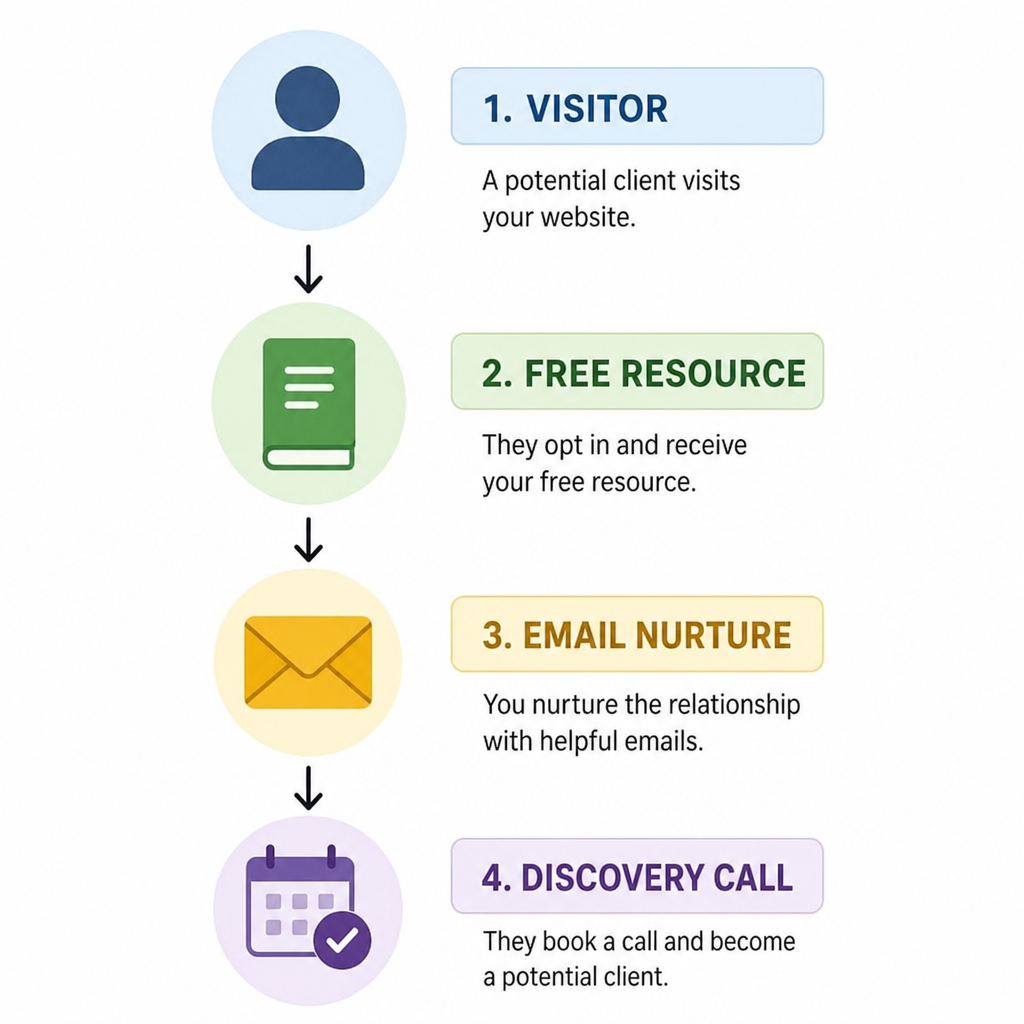
The lead magnet funnel usually follows this path:
- Traffic source: A blog post, podcast appearance, social media post, search result, or referral sends someone to your landing page.
- Opt-in page: The page explains the problem, the value of the resource, and what the subscriber will receive.
- Thank-you page: The subscriber gets the resource and sees a soft next step, such as booking a consultation or reading a related article.
- Email nurture sequence: A short series of emails builds trust, shares your coaching perspective, and introduces your offer.
- Call invitation: The sequence invites qualified prospects to book a discovery call or apply for coaching.
What to include in the lead magnet
Your lead magnet should solve a small but meaningful problem. It should not replace your coaching. Instead, it should help the prospect see their situation more clearly and understand why deeper support may be valuable.
Good lead magnet formats for coaching include:
- A self-assessment or scorecard
- A short workbook with reflection prompts
- A checklist for making a decision
- A template that simplifies a stressful task
- A short video training with one practical framework
- A private audio lesson for a specific challenge
Keep it focused. If the resource takes too long to consume, many prospects will save it and forget it. A useful five-page guide is often stronger than a dense 40-page download.
Action steps to build it
Start by choosing one problem your ideal client already knows they have. Then create a resource that helps them make progress in 10 to 20 minutes. Build a simple landing page with a clear headline, three to five benefit bullets, and an opt-in form.
After someone subscribes, send three to five emails. The first delivers the resource. The next emails can explain a common mistake, share your framework, address objections, and invite the reader to book a call.
This funnel is especially useful if you want a steady list of warm prospects. It also supports long-term visibility because not everyone is ready to buy the day they discover you.
Funnel 2: The webinar or workshop funnel
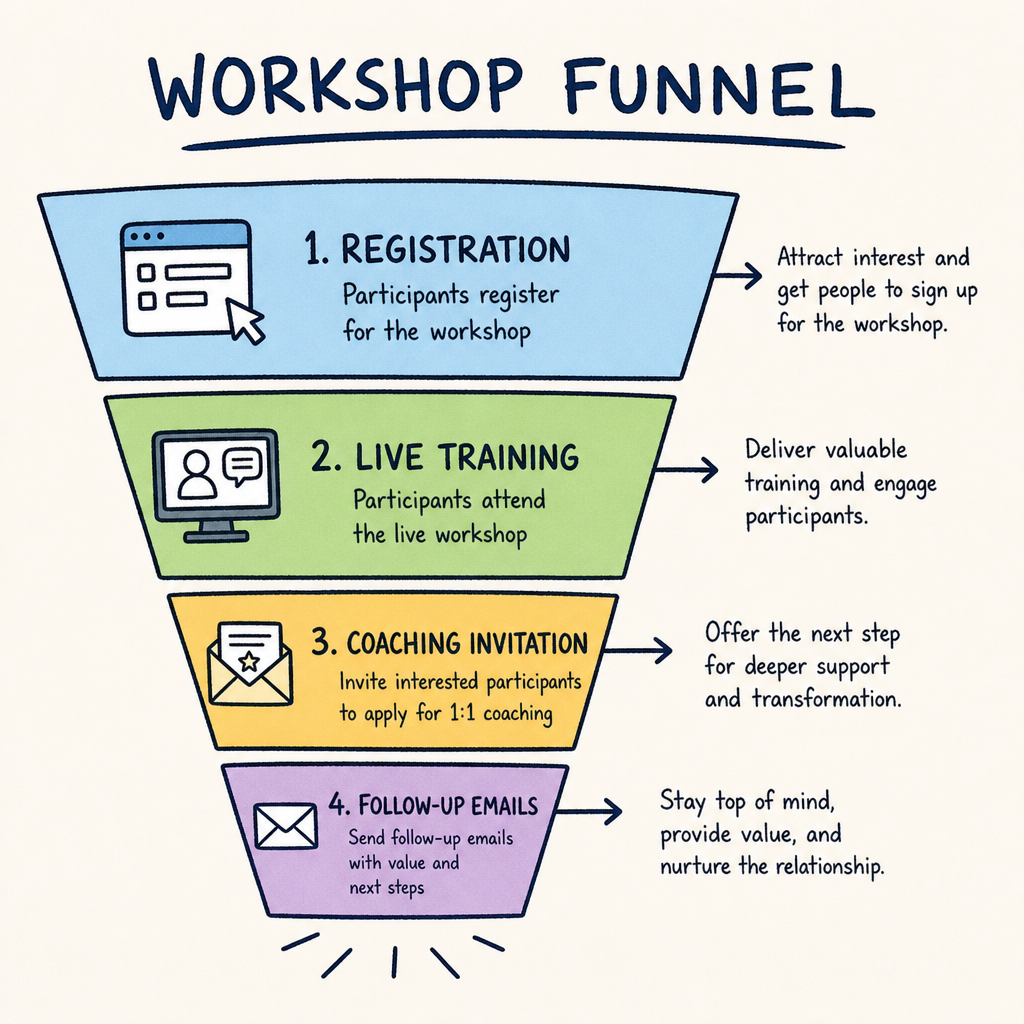
A webinar or workshop funnel is built around a live or recorded teaching session. It works well for coaches because it gives prospects more time with your ideas, your personality, and your method. When done well, it creates trust faster than a simple download.
This type of coaching sales funnel is best when your offer requires explanation. If prospects need to understand why their current approach is not working, what a better framework looks like, and how coaching helps them apply it, a workshop can do that in a structured way.
Why workshops convert well for coaching
Coaching is personal. People want to know how you think, how you communicate, and whether they feel understood by you. A workshop gives them a sample of that experience before they commit.
The goal is not to teach everything you know. The goal is to help attendees understand the problem, see a new possibility, and recognize that support could help them implement it.
A strong coaching workshop usually includes:
- A clear promise tied to one outcome
- A short explanation of who the session is for
- A simple framework with three to five parts
- Examples that make the ideas feel real
- Reflection prompts or quick exercises
- A direct invitation to the next step
How to structure the session
A practical workshop can be 30 to 60 minutes. Open by naming the problem and the result attendees want. Then teach a framework that helps them diagnose where they are stuck.
For example, a leadership coach might teach "The 3 Conversations New Managers Avoid." A health coach might teach "The 4 Habits That Make Consistency Easier." A business coach might teach "The Client Attraction Map for Service Providers."
Near the end, connect the teaching to your coaching offer. Explain who the offer is for, what kind of support it provides, and what the next step looks like. This could be an application, consultation, or strategy call.
Action steps to launch it
Choose a topic that sits directly before your paid offer. If your coaching helps clients make a career transition, do not host a broad productivity webinar. Teach something that naturally leads to the decision your coaching supports.
Then create a registration page with a clear title, three outcomes, and a short note about who should attend. Promote it through email, social media, partners, and past contacts. After the workshop, send a replay, a summary of the framework, and a reminder to book the next step.
This is one of the most effective coaching funnels when you want to combine education with a clear invitation.
Funnel 3: The application funnel
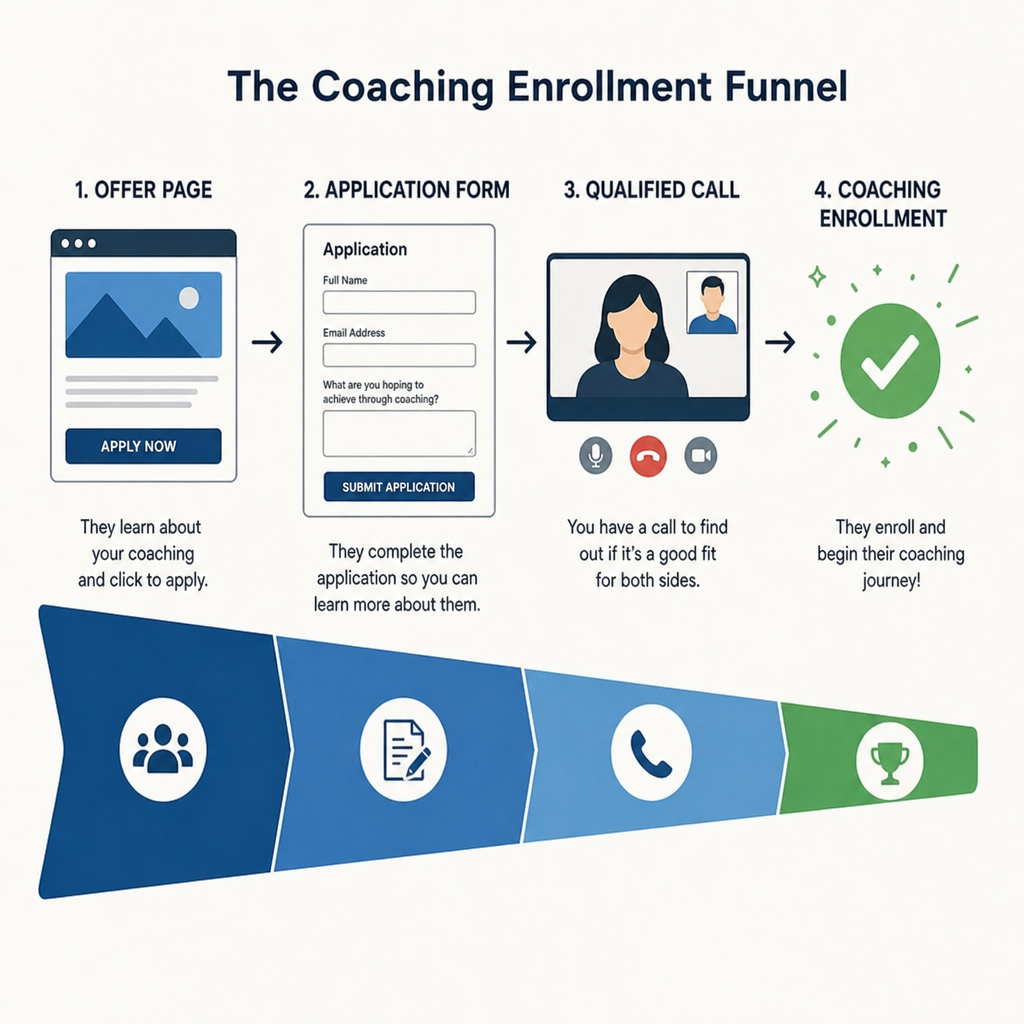
An application funnel asks prospects to complete a short form before booking a call. This helps you filter for fit, understand the prospect's needs, and protect your calendar from conversations that are unlikely to become clients.
It is especially useful for higher-touch coaching, premium packages, group programs, or offers with limited capacity. Instead of sending everyone directly to your calendar, you invite them to apply for a conversation.
When should you use an application funnel?
You should use an application funnel when fit matters as much as interest. If your coaching requires commitment, readiness, or a specific type of client, an application helps both sides make a better decision before a sales call happens.
The application should not feel like a barrier for the sake of exclusivity. It should feel like a thoughtful step that helps you understand whether you can genuinely help. Keep the form focused and respectful of the prospect's time.
What the application should ask
A good application collects enough information to qualify the lead without becoming overwhelming. Ask questions that reveal the prospect's goals, urgency, and readiness.
Useful questions include:
- What challenge are you hoping coaching will help you solve?
- What have you already tried?
- What result would make this support worthwhile?
- Why are you looking for help now?
- Are you ready to invest time, energy, and resources into this change?
- Is there anything important I should know before our conversation?
Avoid asking too many detailed or sensitive questions before trust has been built. You can explore deeper context on the call.
Action steps to create it
Start with a focused coaching offer page. Explain who the coaching is for, what problems it addresses, how the process generally works, and what the next step is. Then place a clear "Apply for a call" button throughout the page.
Keep the application short enough to complete in a few minutes. After submission, send the applicant to a confirmation page that explains what happens next. If they qualify automatically, you can show your booking calendar. If you review applications manually, tell them when they can expect a response.
This funnel works best when paired with strong positioning. The more clearly your page explains who you help and what you help them achieve, the better your applications will be.
Choosing the right funnel for your coaching business
You do not need to build all three funnels at once. In fact, it is usually better to start with one funnel, improve it, and then add another once you know what works.
Use this simple decision guide:
- Choose a lead magnet funnel if you need to build an email list and nurture people over time.
- Choose a webinar or workshop funnel if your prospects need education before they are ready to buy.
- Choose an application funnel if your offer is high-touch, selective, or best sold through qualified conversations.
- Combine a lead magnet with an application funnel if you want long-term nurturing and better-qualified calls.
- Combine a workshop with an application funnel if you want to teach first, then invite serious prospects to apply.
The right funnel depends on your audience, offer, traffic sources, and sales style. A coach with an active social audience may do well with a workshop funnel. A coach investing in SEO may prefer a lead magnet attached to helpful blog content. A coach selling premium one-on-one support may need an application funnel before anything else.
Common mistakes that weaken coaching funnels
Many coaching funnels fail because they are too vague. They talk about transformation but do not name a specific problem, audience, or next step. Prospects may like the content but still feel unsure about whether the coaching is for them.
Another common mistake is asking for the sale too quickly. Coaching decisions often require trust. If your funnel jumps from "nice to meet you" to "buy my program," prospects may back away even if they need help.
Watch for these issues:
- A lead magnet that attracts the wrong audience
- A workshop that teaches too much and never connects to the offer
- An application form that feels too long or impersonal
- Emails that are all promotion and no value
- A call-to-action that is hidden, unclear, or inconsistent
- Messaging that focuses on your process but not the client's desired outcome
A good funnel should feel like a helpful path, not a trap. Each step should make the prospect more informed, more confident, and more ready to decide.
Practical sales funnel tips for better results
Once your funnel is live, improve it based on behavior. Look at where people stop, which emails get replies, and which calls lead to serious conversations. Small changes to the headline, offer, or call-to-action can make the funnel easier to follow.
Use these sales funnel tips as a checklist:
- Make the promise specific. Speak to one audience and one meaningful outcome.
- Keep each page focused. Do not ask visitors to do five different things.
- Use plain language. Prospects should understand the value immediately.
- Nurture before pitching. Share insight, context, and practical help.
- Invite action clearly. Tell people exactly what to do next.
- Follow up consistently. Many prospects need more than one touchpoint.
- Review and refine. Improve the funnel based on real questions, objections, and call quality.
Building a funnel that feels human
The best coaching funnels do more than generate leads. They create a thoughtful experience that helps prospects decide whether your support is right for them. When your funnel is clear, generous, and specific, it builds trust before the sales conversation ever begins.
Start with the funnel that fits your current business stage. Build it simply, test it with real people, and improve the parts that create confusion or friction. With the right coaching sales funnel in place, client attraction becomes less random and more repeatable.
Want to see how we build high-converting sales funnels for coaching businesses? Check out our done-for-you sales funnels or download the free 6-figure coaching system blueprint.
Frequently Asked Questions
Quick answers to the most common questions about this topic.
Get a complete sales funnel — lead capture, nurture, qualification, and booking — built around your coaching offer so your traffic actually converts. done-for-you sales funnel built for coaches.
Related Articles
Best Sales Funnel Builder 2027: Optimize Lead Generation
A complete guide to choosing the best sales funnel builder in 2027. Connect lead capture, screening, automation, pipeline visibility, and sales handoff in one cohesive system.
Sales FunnelsHow to Build a Sales Funnel for Your Coaching Business
Learn how to build a sales funnel for coaches that attracts qualified leads, nurtures trust, and turns prospects into clients with practical online coaching funnels and sales funnel coaching steps.
Sales FunnelsHow to Find the Leaks in Your Coaching Funnel
Your funnel can lose people at almost any point — and each leak is a different problem with a different solution. Here's how to look at the entire journey and find where your traffic is actually going.