9 Sales Funnel Mistakes Online Coaches Make

Kara Leanne
Scalable Coaching Systems Expert · Updated July 1, 2026
Scalable Coaching Systems builds affordable, done-for-you sales funnels for online coaches — so your traffic turns into booked calls instead of bounce rates.
Get a Free Funnel Strategy →Most online coaches do not need a more complicated funnel. They need a clearer path that turns the right strangers into warm leads, then into qualified calls or clients. This list breaks down the biggest sales funnel mistakes coaches make, why they hurt conversions, and how to avoid them with a simpler, more scalable system.
At Scalable Coaching Systems, the goal is not to help coaches collect random leads or copy trendy tactics. It is to build a funnel that matches your offer, your audience, and the way people actually decide to invest in coaching.
Which sales funnel mistakes cost online coaches the most?
The most expensive sales funnel mistakes usually happen before the sales call. If your message is unclear, your lead magnet attracts the wrong people, or your follow-up is weak, prospects lose trust before they ever speak with you. That means you may work harder to create content, run ads, or post daily, while still seeing low-quality leads and inconsistent sales.
The good news is that most funnel problems are fixable. You do not need to rebuild everything at once. Start by finding the weakest point in your funnel, then improve one step at a time.
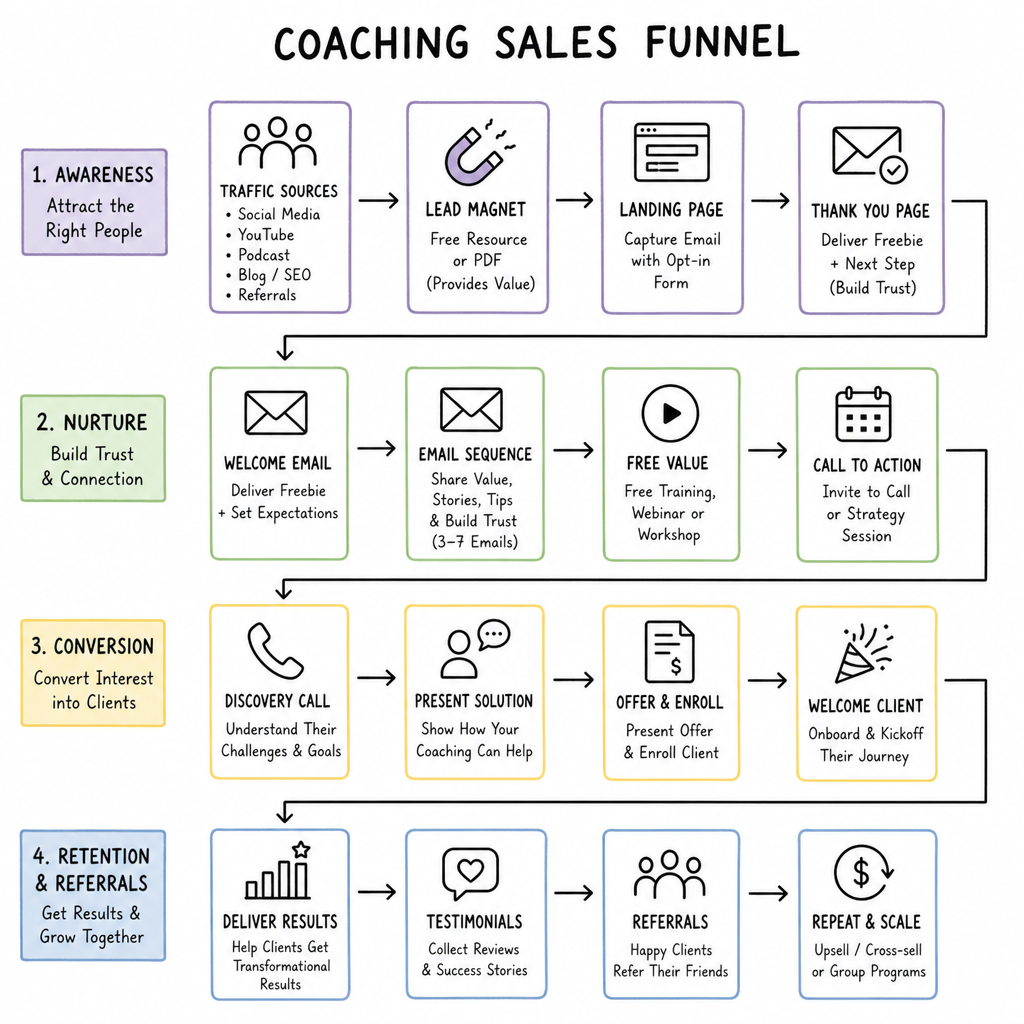
Complete coaching sales funnel flow from audience attraction to conversion and retention.
1. Targeting everyone instead of one clear coaching client
One of the most common marketing mistakes online coaches make is trying to speak to everyone. A life coach may target “people who want more confidence.” A business coach may target “entrepreneurs who want growth.” These groups are too broad to create a message that feels personal.
A strong funnel starts with a specific buyer. Your audience should know the problem you solve, who you solve it for, and what result they can expect to move toward. When your niche is vague, every funnel step becomes weaker: your opt-in page, emails, webinar, sales page, and call script all sound generic.
To avoid this mistake, define your best-fit client with simple detail:
- Their current problem
- The result they want most
- What they have already tried
- What they are afraid will happen if nothing changes
- Why your coaching approach fits their situation
Scalable Coaching Systems often frames this as a message problem before a traffic problem. Better targeting makes every visitor more valuable because your funnel speaks directly to the people most likely to buy.
2. Sending traffic to a weak or unclear offer
Many coaches drive traffic before the offer is ready. They post on social media, run ads, launch a webinar, or build a lead magnet, but the core offer still feels fuzzy. If people cannot quickly understand what you sell and why it matters, they will not take the next step.
Your offer should answer three questions fast: Who is this for? What problem does it solve? What makes the process worth trusting? You do not need to promise overnight success. You do need to show a clear path from where your prospect is now to where they want to be.
A stronger coaching offer includes:
- A clear outcome or transformation
- A defined audience
- A simple delivery structure
- A reason to act now
- A next step that feels easy to take
Avoid stacking vague bonuses or long lists of features. Coaching buyers care about the practical change they will experience. Make that change easy to understand before asking them to book a call or pay.
3. Creating a lead magnet that attracts freebie seekers
A lead magnet should do more than grow your email list. It should attract people who are likely to become clients. If your free resource is too broad, too basic, or disconnected from your paid offer, you may collect leads who enjoy free content but never buy.
For example, a “daily motivation checklist” might attract many downloads, but it may not prepare someone for a premium coaching program. A better lead magnet solves one urgent problem that sits close to your paid offer. It gives a quick win while making the next step feel logical.
Strong lead magnet ideas for online coaches include:
- A scorecard that reveals the prospect’s biggest gap
- A short roadmap that explains the steps to a desired result
- A calculator or worksheet that creates personal insight
- A mini-training that teaches one key shift
- A checklist that helps prospects prepare for a bigger change
This is where many sales funnel mistakes begin. If the wrong people enter the funnel, even great emails and sales calls cannot fully fix it.
4. Asking for the sale before building enough trust
Online coaching is a trust-based sale. Prospects are not only buying information. They are trusting your process, your judgment, and your ability to help them move through a personal or business challenge. If your funnel jumps from cold traffic straight to “book a call,” many people will hesitate.
Trust grows when your funnel shows that you understand the prospect’s situation. Your content should name the real problem, explain why it is happening, and give useful guidance before asking for commitment. This does not mean giving away your entire program. It means showing enough value that a qualified prospect believes the next step is worth their time.
Ways to build trust inside your funnel include:
- A short welcome sequence after opt-in
- A story that explains your method or point of view
- Helpful examples that show how the process works
- Clear expectations about who the offer is and is not for
- Simple proof points, if you have permission to share them
If you do not have testimonials or case studies yet, do not invent them. Use clarity, education, and honest positioning instead.
5. Making the funnel too complicated too soon
A complicated funnel can look impressive, but it often creates more problems than it solves. Newer coaches may build multiple lead magnets, long email sequences, tripwire offers, webinars, application pages, and retargeting campaigns before they have proven the core message.
Complexity makes it harder to know what is working. If conversions are low, you may not know whether the issue is your traffic, landing page, emails, offer, or sales call. A simple funnel is easier to test and improve.
A lean funnel for many online coaches can start with:
- A focused traffic source
- One high-intent lead magnet or training
- A short email nurture sequence
- A clear call-booking or application page
- A follow-up process for qualified leads
Scalable Coaching Systems focuses on practical structure because scaling a broken funnel only creates bigger problems. Prove the path first, then add more automation or traffic.
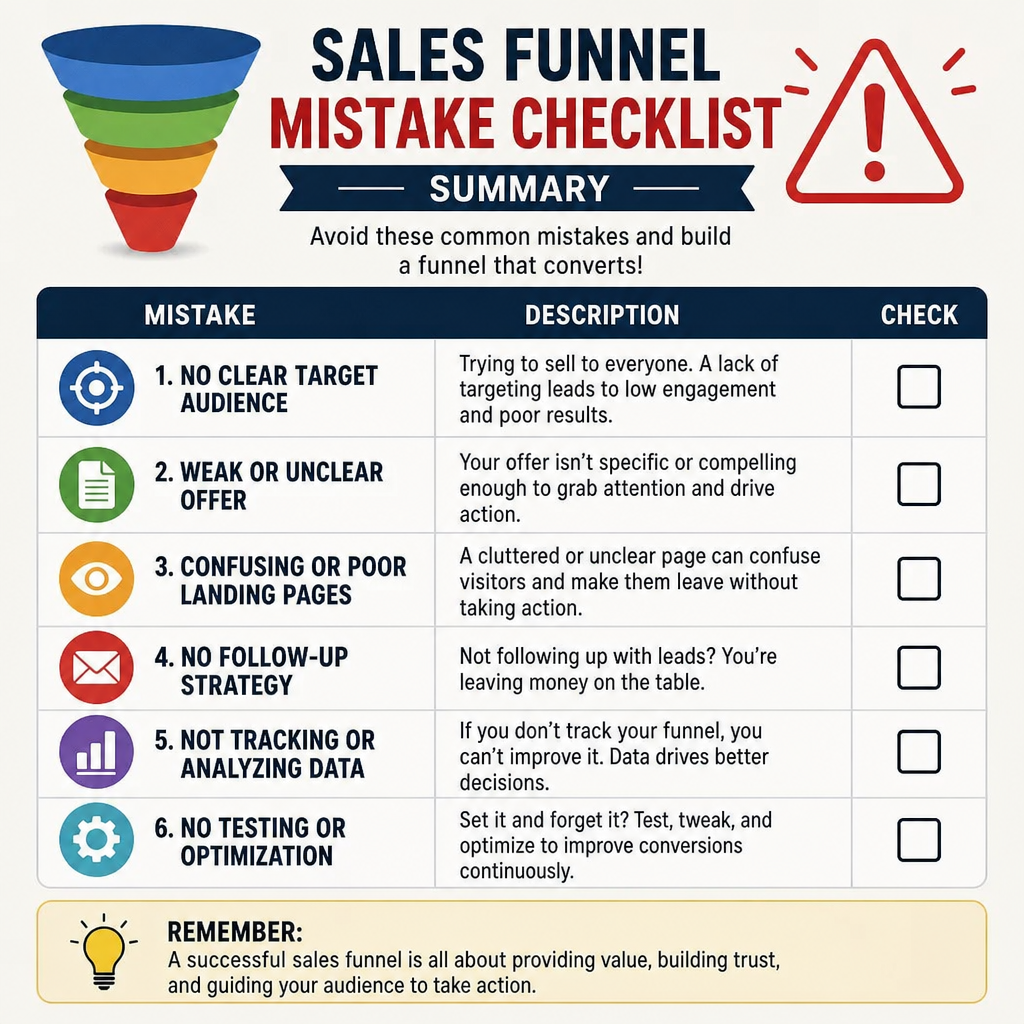
Sales funnel mistake checklist summary and common pitfalls.
6. Writing emails that teach but never move people forward
Educational emails are useful, but they should still guide the reader toward a decision. Many coaches send tips, stories, and inspiration without connecting the content to the next step. As a result, subscribers may like the emails but never become buyers.
Each email should have a job. One email may build belief. Another may challenge a false assumption. Another may explain the cost of staying stuck. Another may invite the reader to book a call, watch a training, or reply with a question.
A simple nurture sequence could include:
- Email 1: Deliver the promised resource and introduce your point of view
- Email 2: Name the core problem your audience is facing
- Email 3: Explain why common solutions fail
- Email 4: Share your process or framework
- Email 5: Invite qualified readers to take the next step
This is one of the common mistakes in sales funnel and how to avoid them: do not treat email as random content. Treat it as a guided conversation.
7. Hiding the next step or making it hard to take
If people have to search for what to do next, your funnel is leaking leads. Coaches often bury the call to action at the bottom of a long page, use unclear button text, or offer too many choices at once. Confusion lowers conversions.
Your next step should be easy to see, easy to understand, and easy to complete. If the goal is to book a call, say that clearly. If the goal is to apply, explain who should apply and what happens after they submit the form.
Make your call to action stronger by using plain language:
- “Book a coaching fit call”
- “Apply for private coaching”
- “Get the free roadmap”
- “Watch the training”
- “See if this program is right for you”
Also remove extra friction. Do not ask for unnecessary details too early. Do not send people through five pages when one clear page will do. The easier the next step feels, the more likely qualified prospects are to take it.
8. Ignoring sales call quality after the funnel works
A funnel can bring in qualified leads, but the sales conversation still matters. Some coaches blame the funnel when the real issue is the call process. If many good-fit prospects book calls but do not buy, review what happens after booking.
A strong sales call is not pressure. It is a clear conversation that helps both sides decide if there is a fit. You should understand the prospect’s goals, current problem, past attempts, urgency, and ability to commit. You should also explain your offer in a way that connects to their specific situation.
Improve your call process by checking:
- Whether the application form qualifies leads properly
- Whether reminder emails reduce no-shows
- Whether the call has a clear structure
- Whether you ask enough discovery questions
- Whether your offer explanation is simple and relevant
- Whether follow-up is timely and respectful
If your funnel creates calls but not clients, do not add more traffic yet. First, improve the conversion point closest to the sale.
9. Tracking vanity numbers instead of conversion metrics
Many coaches track likes, views, followers, or email list size. These numbers can be useful, but they do not tell the full story. A smaller audience with strong buyer intent can outperform a large audience that never takes action.
The funnel metrics that matter most are the ones tied to movement. Track how many people visit your landing page, opt in, open emails, click, book calls, show up, qualify, and become clients. This helps you see where the funnel is strong and where it needs work.
Key numbers to review each month include:
- Landing page conversion rate
- Lead source quality
- Email click rate
- Call booking rate
- Application completion rate
- Show-up rate
- Sales call close rate
- Revenue by lead source
Scalable Coaching Systems encourages coaches to make decisions from real funnel behavior, not emotion. When you know the numbers, you can stop guessing and start improving the right step.
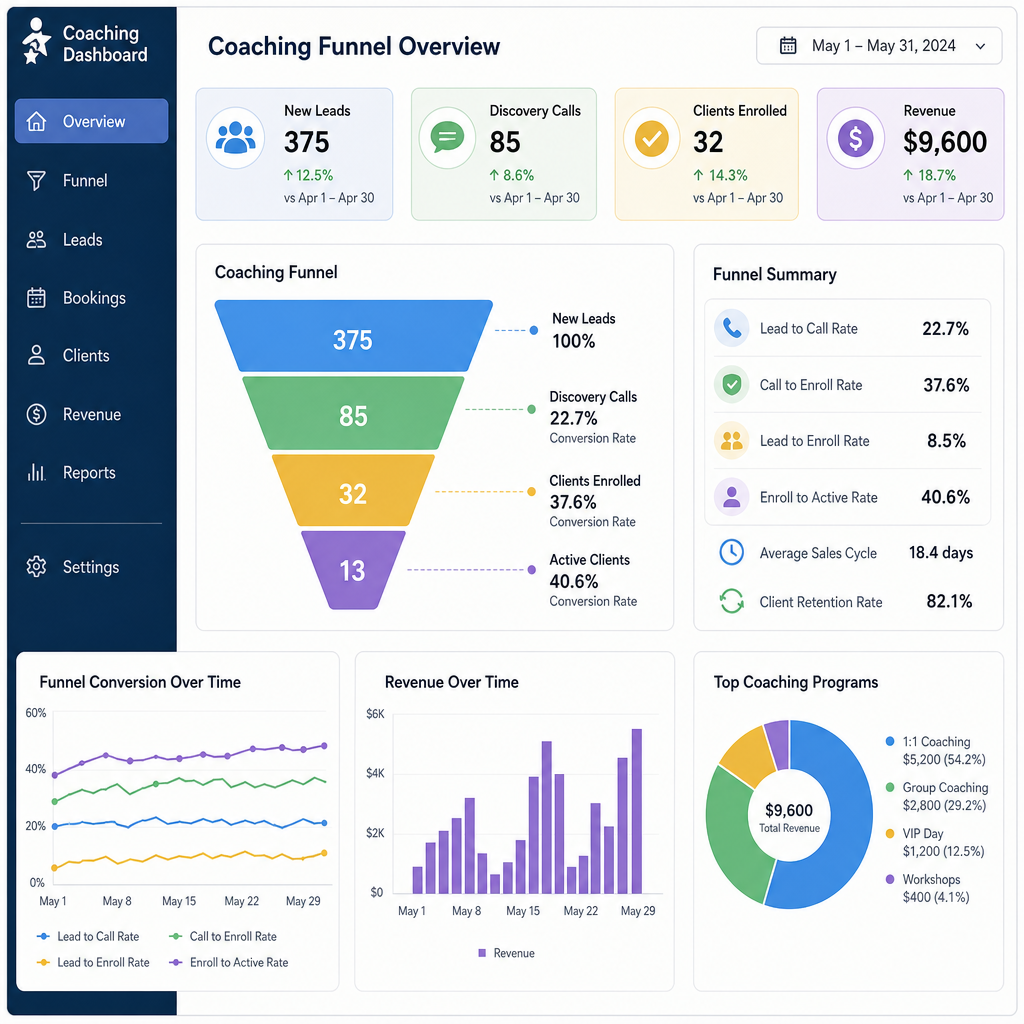
Coaching funnel dashboard with conversion funnel rates and top coaching program revenue metrics.
How should online coaches fix these funnel mistakes first?
Start with the part of the funnel closest to revenue, then work backward. If you are booking calls but not closing, improve your sales process. If you are getting leads but not calls, improve your nurture and offer. If you are not getting leads, improve your message, lead magnet, and traffic source.
Use this simple action plan:
- Clarify your ideal client and core promise.
- Make sure your paid offer is easy to understand.
- Build one lead magnet that connects to that offer.
- Write a short nurture sequence with a clear purpose.
- Make the next step obvious on every key page.
- Review sales calls and follow-up before adding more traffic.
- Track conversion metrics monthly and improve one bottleneck at a time.
This approach keeps you from fixing random pieces. It also helps you avoid the common habit of rebuilding everything when only one step is actually weak.
Build a funnel that supports better coaching sales
The biggest sales funnel mistakes are rarely about one broken button or one bad email. They usually come from unclear positioning, weak offer structure, poor follow-up, or a lack of useful data. When you simplify the funnel and guide prospects with intention, your marketing becomes easier to manage and more likely to convert.
If you want a clearer path, Scalable Coaching Systems offers a free blueprint and services designed to help online coaches build a more reliable client-acquisition system. Use it as a starting point to review your funnel, spot the leaks, and choose the next smart improvement without overcomplicating the process.
Frequently Asked Questions
Quick answers to the most common questions about this topic.
Get a complete sales funnel — lead capture, nurture, qualification, and booking — built around your coaching offer so your traffic actually converts. done-for-you sales funnel built for coaches.
Related Articles
Best Sales Funnel Builder 2027: Optimize Lead Generation
A complete guide to choosing the best sales funnel builder in 2027. Connect lead capture, screening, automation, pipeline visibility, and sales handoff in one cohesive system.
Sales FunnelsHow to Build a Sales Funnel for Your Coaching Business
Learn how to build a sales funnel for coaches that attracts qualified leads, nurtures trust, and turns prospects into clients with practical online coaching funnels and sales funnel coaching steps.
Sales FunnelsHow to Find the Leaks in Your Coaching Funnel
Your funnel can lose people at almost any point — and each leak is a different problem with a different solution. Here's how to look at the entire journey and find where your traffic is actually going.