
You can build a steady coaching practice without posting every day, chasing algorithms, or trying to become a personal brand influencer. The goal is to create a simple client acquisition system built on relationships, referrals, partnerships, direct outreach, strong follow-up, and excellent client engagement. This guide walks you through practical steps for finding coaching clients without social media while also improving client retention so your business is less dependent on constant promotion.
Can you really get coaching clients without social media?
Yes, you can get coaching clients without social media if you replace visibility-based marketing with trust-based marketing. Instead of trying to reach thousands of strangers, you focus on the right people, warm relationships, clear offers, and conversations that lead to real buying decisions. This approach is especially effective for coaches because clients usually buy coaching when they feel understood, respected, and confident that you can help them make progress.
Social media can be useful, but it is not the only path to growth. Many coaching clients come through referrals, past colleagues, professional groups, workshops, email lists, podcasts, local communities, and strategic partnerships. The key is to make your value easy to understand and easy to recommend.
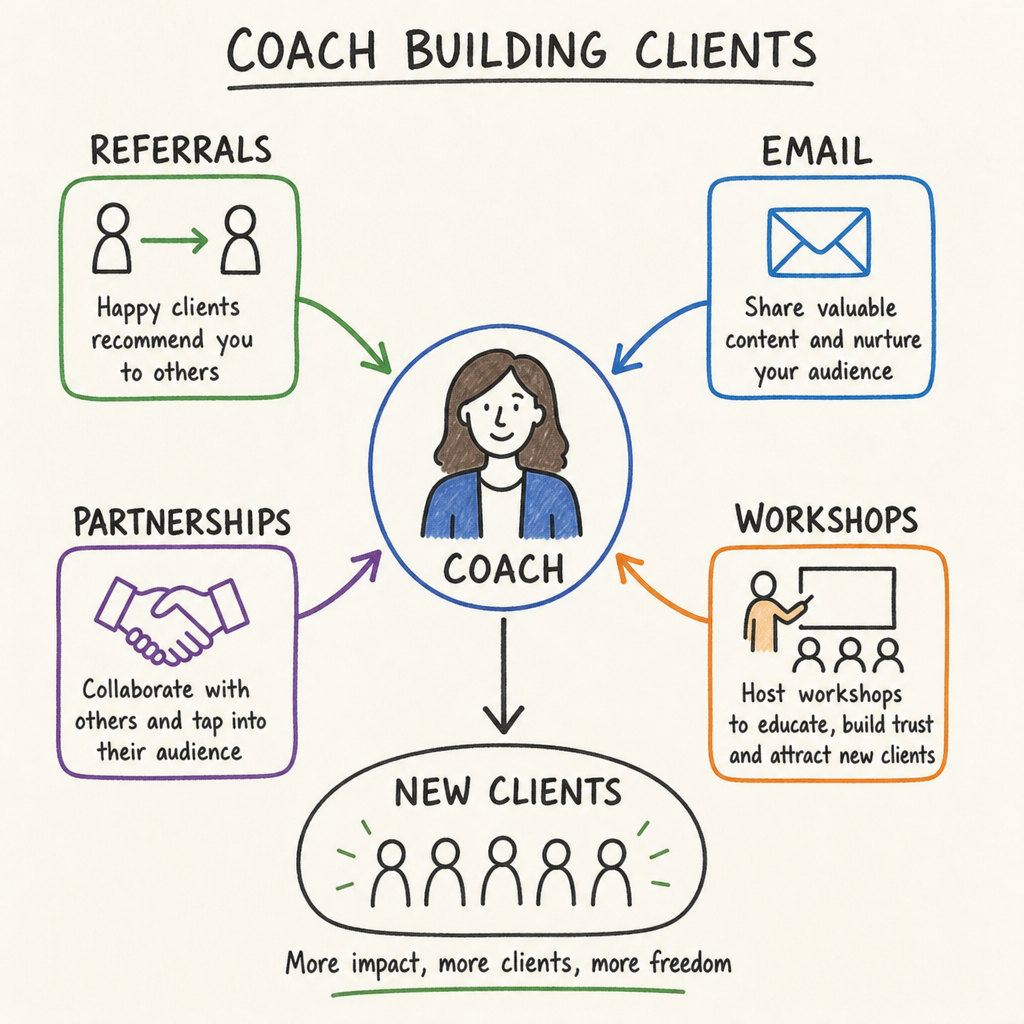
Coach building clients through referrals, email, partnerships, and workshops.
Build the foundation before you start outreach
Before you ask for referrals or start booking calls, clarify what you help people do. Vague coaching offers are hard to recommend. Clear offers travel faster because people can immediately think, “I know someone who needs that.”
Define your niche in practical language. You do not need a clever label or a perfect tagline. You need a clear answer to three questions:
- Who do you help?
- What problem, goal, or transition do you help them with?
- What outcome should they expect to move toward?
For example, “I help new managers lead with more confidence” is easier to understand than “I help people unlock their potential.” A leadership coach, wellness coach, career coach, executive coach, or life coach can all use this same principle. Specificity makes your work easier to explain, easier to remember, and easier to refer.
Also prepare a short coaching offer before you begin outreach. This may include a discovery call, a short assessment, a starter package, or a defined coaching program. Keep it simple. People should know what the next step is, how to take it, and why it is useful.
Follow these steps to win coaching clients without social media
The strongest offline and non-social strategy is not one tactic. It is a repeatable sequence. Work through these steps in order, then repeat them each month.
Define a narrow ideal client profile
Start by choosing one audience to prioritize for the next 60 to 90 days. This does not mean you can never work with anyone else. It means your marketing becomes easier because your message has one clear target.
Write a short profile of your ideal client. Include their role, life stage, current challenge, desired result, and what may be stopping them from getting help. A career coach might focus on mid-career professionals who feel stuck but are unsure whether to change jobs or industries. A health coach might focus on busy professionals who want better routines but struggle with consistency.
This step matters because every later action depends on it. Your outreach, referral requests, workshops, email topics, and discovery calls will all be stronger when they speak to a specific person with a specific need.
Turn your offer into a clear sentence
Once you know who you want to reach, write your offer in one sentence. Use plain language, not coaching jargon. A strong sentence sounds like something a client would say to a friend.
Use this format:
- “I help [specific person] with [specific challenge] so they can [desired outcome].”
Then make the next step clear. For example, “I offer a 30-minute fit call to understand what is going on and see whether coaching would help.” If you offer a paid introductory session, say that clearly. If you offer a free consultation, explain what happens during it and what the person will leave with.
A clear offer improves conversion because it reduces uncertainty. People are more likely to respond when they know exactly what you do and what happens next.
Reconnect with your warm network
Your warm network is one of the best places to find coaching clients without social media. These are people who already know you, trust you, or have worked with you before. They may not need coaching themselves, but they may know someone who does.
Make a list of 50 to 100 people, including former colleagues, classmates, clients, managers, collaborators, community contacts, and professional acquaintances. Do not send a mass message. Write personal notes that feel human and specific.
A simple message can look like this:
“Hi [Name], I hope you’ve been well. I’m currently working with [type of client] who are dealing with [challenge]. If someone in your circle is looking for support with that, I’d be grateful if you kept me in mind. I’d also love to hear what you’re working on lately.”
The final sentence matters. Good networking is not extraction. It is reconnection. When you show interest in others, conversations become warmer and more natural.
Ask for referrals with clarity
Many coaches say they want referrals, but they never teach people how to refer them. Your contacts need to know who you help, what signs to look for, and how to make the introduction.
Instead of saying, “Let me know if you know anyone,” be more specific. You might say, “If you know a new director who is struggling to delegate and feels overwhelmed by team leadership, I’d be happy to speak with them.” This gives the other person a mental picture.
Make referrals easy by providing a short introduction they can forward. Keep it conversational, not overly polished. Include who you help, the problem you address, and the best way to connect. The easier you make the referral process, the more likely people are to follow through.
Create a simple email follow-up system
Email is one of the most reliable channels for coaches because it gives you a direct line to people who have already shown interest. You do not need a large list. A small list of engaged contacts can produce better results than a large audience that never hears from you in a meaningful way.
Start with a basic monthly email. Share one useful idea, one practical exercise, or one short story from your coaching perspective without revealing confidential details. End with a clear invitation, such as booking a call, replying with a question, or joining a workshop.
For stronger client engagement, segment your contacts when possible. Past clients may appreciate check-ins or advanced resources. New leads may need clarity on your process. Referral partners may benefit from a quick reminder of who you help. The more relevant your follow-up feels, the more trust you build.
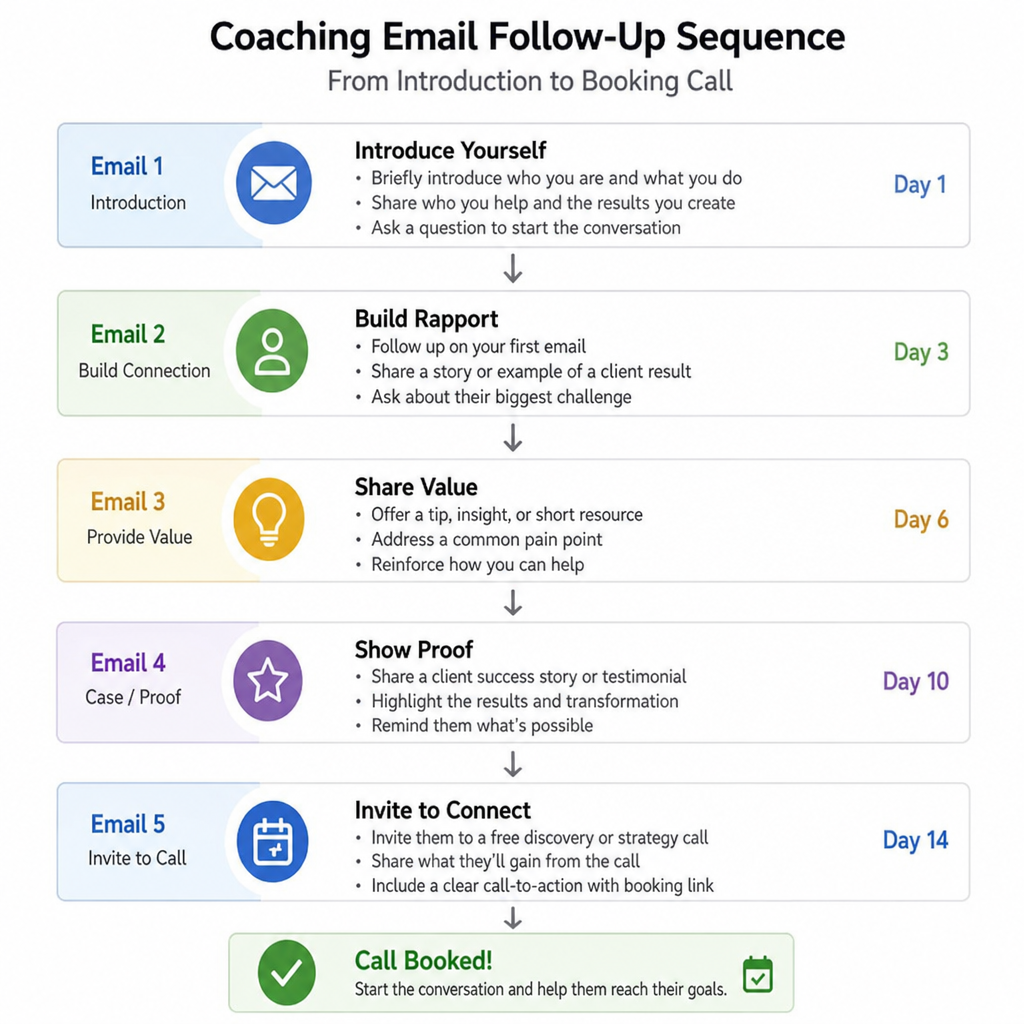
Coaching email follow-up sequence from introduction to booking call.
Offer small workshops or private trainings
Workshops help potential clients experience your coaching style before they commit. You can run them for companies, associations, coworking spaces, alumni groups, wellness communities, or professional networks. They work because they create trust at scale without requiring you to post online every day.
Choose a topic that solves a real, urgent problem for your ideal client. Avoid broad themes like “personal growth” if your audience needs something more concrete. Better topics might include “How New Managers Can Give Clear Feedback,” “How to Navigate a Career Crossroads,” or “How to Build Better Habits During a Busy Season.”
At the end, invite participants to take a next step. This could be a coaching consultation, a short assessment, or a follow-up session. Keep the invitation calm and direct. You are not pressuring anyone; you are showing them how to continue if the session was useful.
Build partnerships with adjacent professionals
Partnerships can become a steady source of coaching clients without social media. Look for professionals who serve the same audience but solve a different problem. Career coaches might partner with resume writers, recruiters, HR consultants, or therapists. Wellness coaches might connect with personal trainers, nutrition professionals, physicians, or workplace wellness teams, while staying within their own scope of practice.
A good partnership is built on mutual relevance. Do not ask for referrals before you understand the other person’s work. Start with a conversation about who they serve, what their clients struggle with, and where coaching might complement their services.
Then propose something low-risk. You could exchange referral guidelines, co-host a workshop, write a guest resource for their audience, or offer a private session for their community. When the collaboration helps their clients, they have a real reason to introduce you.
Use discovery calls as coaching conversations, not sales scripts
A discovery call should help both people decide whether coaching is the right fit. It should not feel like a performance or a hard sell. The best calls are structured, calm, and client-centered.
Start by asking what prompted the person to book the call. Then explore what they have tried, what has not worked, what they want instead, and what support would feel useful. Reflect back what you hear so the person feels understood.
Near the end, explain how you would approach the work. Be clear about the structure, expectations, and next step. If it is a fit, invite them to begin. If it is not, say so respectfully. Trust grows when you are willing to be honest.
Improve the client experience after enrollment
Client acquisition becomes easier when client retention is strong. Retained clients may continue working with you, return later, or refer others because they trust the experience. That means your marketing does not end when someone signs up.
Create a clear onboarding process. Explain how sessions work, what the client should prepare, how communication happens between sessions, and how progress will be reviewed. When clients understand the process, they feel safer and more engaged. Once your client volume grows, you can evaluate when to hire a VA vs a funnel expert to build or manage these onboarding automations.
Use simple check-ins throughout the engagement. Ask what is helping, what feels unclear, and what they want to focus on next. These questions improve client engagement and help you adjust before small concerns become reasons to leave.
Track your client-generating activities every week
If you are not relying on social media, you need to track relationship-based activity. This keeps your business development consistent, even when you are busy serving clients.
Each week, record:
- New warm outreach messages sent
- Referral conversations started
- Follow-ups completed
- Discovery calls booked
- Workshops pitched or delivered
- Partnership conversations held
- Past clients checked in with
- New clients enrolled
This does not need to be complicated. A spreadsheet, notebook, or customer relationship management tool can work. The point is to see which activities create conversations and which conversations create clients. Over time, you can focus on what works and stop doing what does not.
What should you say when reaching out?
Your outreach should be personal, brief, and relevant. The goal is not to convince someone in the first message. The goal is to start a real conversation or make it easy for someone to introduce you to the right person.
Use these templates as starting points, then customize them.
For reconnecting:
“Hi [Name], I was thinking about your work with [specific context] and wanted to reconnect. I’m currently coaching [audience] around [challenge]. I’d love to hear what you’re focused on these days, and if anyone comes to mind who could use support with [specific issue], I’d be grateful for an introduction.”
For past clients:
“Hi [Name], I hope things have been going well since our work together. I’m opening a few spots for [type of coaching] and thought of you because you may know people navigating [challenge]. If someone comes to mind, I’d be happy to be a resource.”
For partnership conversations:
“Hi [Name], I noticed that we both support [audience], though in different ways. I’d enjoy learning more about your work and exploring whether there may be a useful way to support each other’s clients.”
Keep your tone warm and low-pressure. If someone does not respond, follow up once or twice with respect. Silence is not rejection; people are busy.
Strengthen trust with proof and presence
Even without social media, people need a way to understand your work. Create a simple website or one-page profile that explains who you help, what coaching with you looks like, and how to take the next step. It does not need to be elaborate. It needs to be clear.
Include elements that reduce doubt:
- A plain-language description of your coaching focus
- The types of clients or challenges you support
- Your process or program structure
- Testimonials or outcomes if you have permission to use them
- A short professional bio
- A direct call to action
If you do not have testimonials yet, do not invent them. Instead, strengthen your page with clear explanations, useful resources, and a confident description of your process. Trust can come from clarity as well as proof.
Make retention part of your growth strategy
Client retention is not just about keeping clients longer. It is about helping clients stay connected to the value of the work. When clients understand their progress, they are more likely to continue, complete the process, or recommend you to others.
Build retention into your coaching rhythm. At the beginning of an engagement, define what progress could look like. During the engagement, revisit goals and name what has changed. Near the end, discuss next steps, maintenance, or future support.
A simple retention checklist can help:
- Set clear expectations before the first paid session
- Review goals regularly
- Send helpful recaps or action points when appropriate
- Invite honest feedback during the engagement
- Celebrate progress in concrete terms
- Offer a clear renewal, completion, or next-step conversation
- Stay in touch after the engagement ends
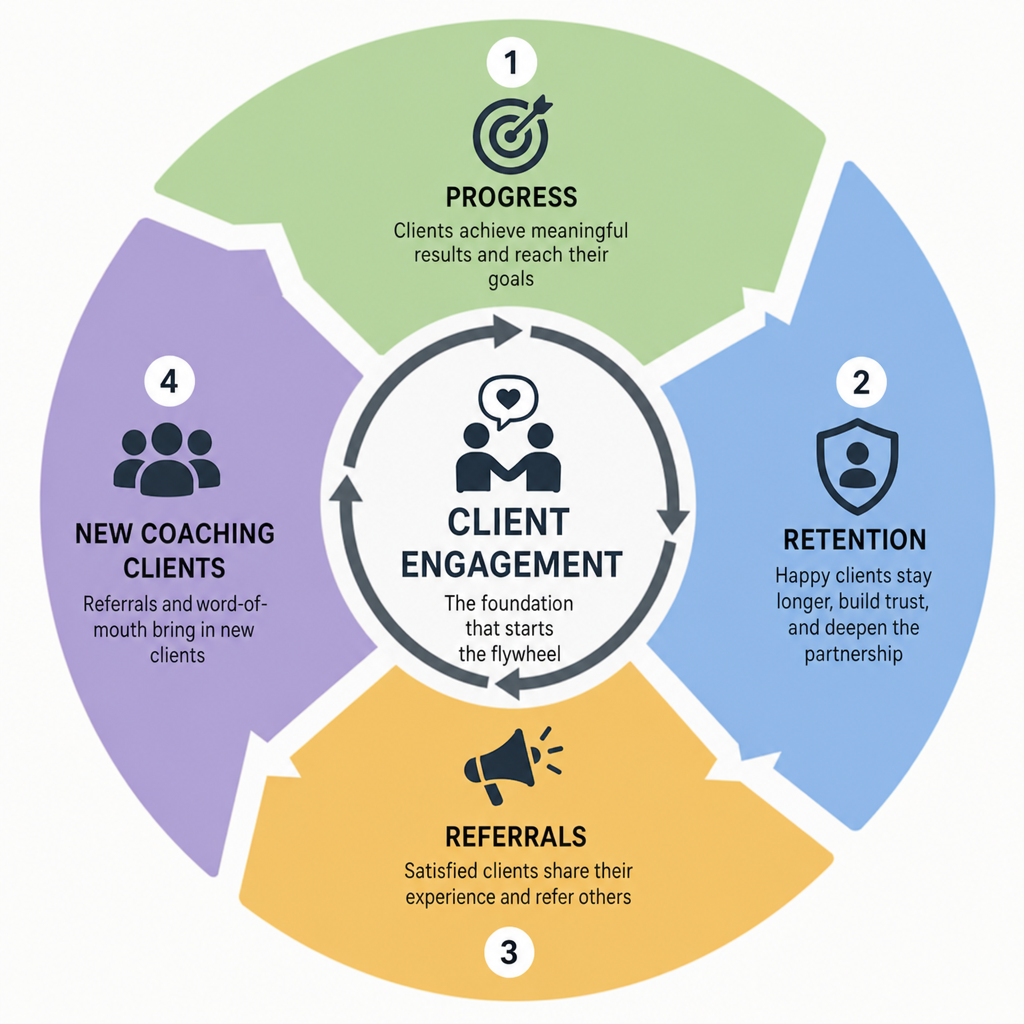
Flywheel showing client engagement leading to progress, retention, referrals, and new coaching clients.
Keep the system simple and repeatable
The biggest mistake coaches make is trying a tactic once, then abandoning it too quickly. Relationship-based marketing compounds. A message sent today may become a referral months later. A workshop may lead to one client now and several introductions later. A past client check-in may restart a conversation at exactly the right time.
Choose a weekly rhythm you can maintain. For example, you might send five warm outreach messages, follow up with three existing conversations, contact one potential partner, and write one useful email to your list. That is enough to create momentum if you do it consistently.
Getting coaching clients without social media is not about hiding from marketing. It is about choosing marketing that fits the way coaching is actually bought: through trust, relevance, timing, and conversation. Build a clear offer, nurture real relationships, deliver excellent client engagement, and make client retention part of the plan. Over time, you will have a calmer, more durable path to new clients.
Build Your Client-Getting System
If you're ready to stop depending on algorithms and build a reliable backend lead generation system for your coaching business, let's connect.
Explore the Lead Generation System for Coaches →Frequently Asked Questions
Quick answers to the most common questions about this topic.