How to Build an Email Nurture Sequence for Coaching Leads

Kara Leanne
Scalable Coaching Systems Expert · Updated July 7, 2026
Scalable Coaching Systems builds affordable, done-for-you email marketing systems for online coaches — so your list turns into paying clients on autopilot.
Get a Free Funnel Strategy →An email nurture sequence for coaching leads helps turn curious subscribers into informed, motivated prospects who understand your coaching offer and feel ready to take the next step. Instead of sending one-off promotions, you create an email drip campaign that builds trust, answers objections, and guides each lead toward a clear action. The best lead nurturing emails feel personal, timely, and useful—not like a hard sell disguised as advice.
What should an email nurture sequence for coaching leads accomplish?
An email nurture sequence for coaching leads should move a person from initial interest to confident consideration. That means your emails must clarify the problem you help solve, show your coaching perspective, create small moments of self-recognition, and invite the reader into a relevant next step such as booking a call, replying, joining a webinar, or reviewing a coaching program page.
Before you write, remember that coaching is built on trust. Your sequence should not simply “educate” in a broad way; it should help the lead see what is possible, what may be keeping them stuck, and why your method is a credible path forward. A strong sequence respects the reader’s pace while still giving them momentum.
1. Define the coaching lead you want to nurture
Start by identifying exactly who the sequence is for. A lead who downloaded a “career clarity” worksheet needs a different message from someone who attended a leadership coaching webinar or clicked a pricing page. If you write to everyone, your lead nurturing emails will feel vague, and vague emails are easy to ignore.
Create a simple profile for the lead before drafting. Focus on the situation that brought them into your world, the outcome they want, and the hesitation that may stop them from taking action. This keeps the email drip campaign grounded in the reader’s real context.
Use these prompts:
- Source: How did this person join your list?
- Need: What problem or aspiration were they responding to?
- Awareness level: Are they just exploring, actively comparing, or nearly ready?
- Primary blocker: Do they doubt coaching works, doubt themselves, worry about cost, or lack urgency?
- Best next step: What action would naturally help them move forward?
For example, a new lead from a free guide may need reassurance and education. A lead from a sales page may need proof, clarity, and a direct invitation. This distinction shapes the full sequence.
2. Choose one conversion goal for the email drip campaign
Every email nurture sequence needs one primary destination. Without a defined goal, your emails may become a loose collection of tips with no clear business purpose. For coaching leads, the goal is often to book a discovery call, apply for a program, attend a live session, or reply with a specific challenge.
Choose a goal that matches the lead’s readiness. If the lead is cold, asking for a paid commitment immediately may feel premature. If the lead is warm, sending only general inspiration may waste attention. The goal should be ambitious enough to support your coaching business but natural enough to feel helpful.
A good sequence goal sounds like this:
- For new subscribers: Encourage them to reply with their biggest challenge or explore your core coaching framework.
- For webinar attendees: Invite them to book a consultation related to the topic they just learned.
- For application page visitors: Follow up with clarity, objections, and a direct application reminder.
- For inactive leads: Re-engage them with a reflective question or updated resource.
Once you set the goal, every email should support it. That does not mean every message must be promotional. It means each message should make the next step feel more relevant, safer, and more valuable.
What do you need before writing lead nurturing emails?
Before writing lead nurturing emails, gather the core ingredients: your audience segment, your sequence goal, your coaching promise, your key objections, and your call to action. You do not need a complex automation map at first, but you do need a clear reason each email exists.
Create a short “sequence brief” before drafting. This saves time and prevents the emails from drifting into disconnected coaching advice. Your brief should include the offer you are guiding people toward, the transformation your coaching supports, and the emotional state of the lead when they first enters the sequence.
Include these elements:
- Lead magnet or entry point: The resource, event, quiz, referral, or page that triggered the sequence.
- Coaching angle: The main belief, method, or framework you want the lead to understand.
- Objections: The doubts you need to address without sounding defensive.
- Decision criteria: What the lead needs to believe before taking action.
- CTA: The one action you want them to take by the end.
- Tone: Supportive, direct, reflective, strategic, warm, or another style that fits your coaching brand.
This brief does not have to be formal. Even a one-page outline can keep your email drip campaign focused and consistent.
3. Map the journey from problem-aware to action-ready
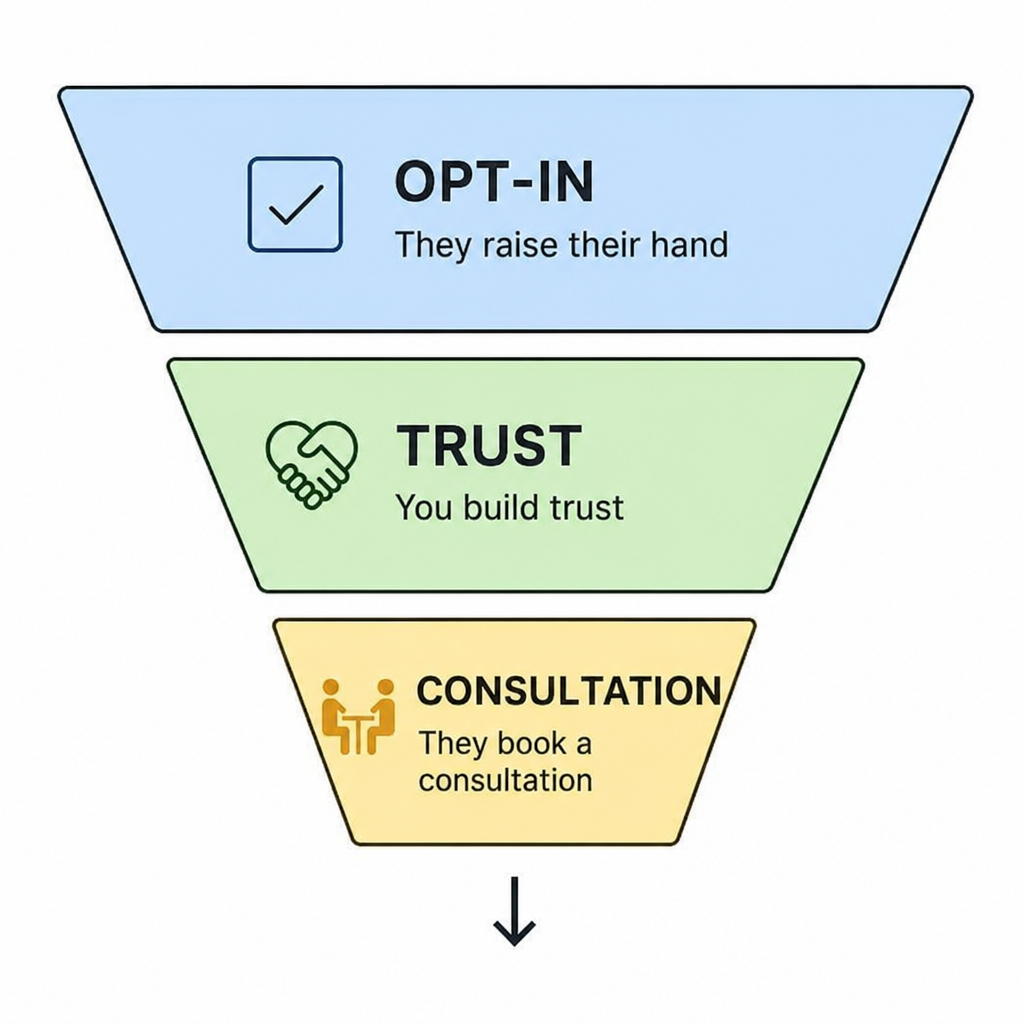
A coaching lead usually moves through several mental stages before taking action. They may first recognize a problem, then look for language to describe it, then consider what change requires, then decide whether your coaching is the right support. Your sequence should guide that progression step by step.
Think of the sequence as a conversation that unfolds over time. Each email should answer the next natural question in the lead’s mind. If you jump straight to “book a call” without building context, the ask may feel too sudden. If you never make a clear ask, the lead may enjoy your content but never engage.
A simple journey might look like this:
- Welcome: Confirm why they are here and set expectations.
- Problem clarity: Name the challenge in a way that feels specific and relatable.
- Insight: Teach a useful concept from your coaching approach.
- Reframe: Challenge a limiting belief or common misconception.
- Possibility: Show what progress can look like without inventing guarantees.
- Invitation: Offer the next step clearly and confidently.
- Reminder or objection email: Address hesitation and restate the value of acting now.
This structure keeps the email nurture sequence for coaching leads practical rather than random. It also gives you a reliable framework you can adapt for different lead sources.
4. Write a welcome email that builds immediate trust
Your welcome email is not a throwaway confirmation. It is the first real moment of relationship-building after the lead opts in. Use it to acknowledge what they asked for, remind them why the topic matters, and tell them what kind of support or perspective they can expect from you.
Keep the email simple and human. Thank them for joining, deliver the promised resource if there is one, and connect the resource to a broader coaching outcome. Then invite a small action, such as reading the guide, replying with a challenge, or watching the first video.
A strong welcome email includes:
- Recognition: “You’re here because you want more clarity around…”
- Delivery: Link or explain how to access the promised resource.
- Positioning: Briefly explain your coaching perspective.
- Expectation: Tell them what you will send next and why it will help.
- Micro-CTA: Ask for one simple action, not five competing clicks.
Do not overload this first message with your full story, every credential, and a hard pitch. The goal is to create safety and relevance. If the lead thinks, “This person understands what I’m dealing with,” the sequence is off to a strong start.
5. Teach one practical insight per email
The most effective lead nurturing emails are useful without becoming overwhelming. Each message should deliver one clear insight, not a full coaching curriculum. When you try to teach too much at once, the reader may save the email for later and never return.
Choose insights that lead naturally toward your coaching offer. For example, a leadership coach might explain why high performers struggle to delegate. A wellness coach might unpack the difference between motivation and sustainable routines. A business coach might show why scattered offers create inconsistent sales conversations.
Use this simple email structure:
- Hook: Name a relatable moment, question, or mistake.
- Insight: Explain one coaching idea in plain language.
- Application: Give a small reflection prompt or action step.
- Bridge: Connect the insight to the larger transformation.
- CTA: Invite the reader to reply, click, book, or continue.
This approach makes your email drip campaign feel like a guided experience rather than a lecture. It also positions coaching as the place where the reader can apply insight with support, accountability, and direction.
6. Build credibility without overproving
Coaching leads need a reason to trust you, but credibility does not have to mean a wall of claims. You can build trust through clarity, specificity, client-centered language, and your ability to name the problem accurately. When you describe the reader’s experience with precision, you demonstrate understanding.
Use credibility elements where they genuinely fit. If you have approved testimonials, case studies, credentials, or relevant experience, include them in a focused way. If you do not have those assets, lean on your framework, process, philosophy, and the quality of your guidance rather than inventing proof.
Helpful credibility signals include:
- A clear coaching framework: Show how you think, not just what you sell.
- Specific examples: Describe common situations your ideal clients face.
- Ethical testimonials: Use only real, approved client language where permitted.
- Process clarity: Explain what happens on a call or inside the program.
- Boundaries: Be honest about who the coaching is and is not for.
Trust grows when the reader feels respected. Avoid exaggerated promises, pressure tactics, or claims that coaching will solve everything. A grounded voice often feels more credible than a louder one.
How many emails should a coaching nurture sequence include?
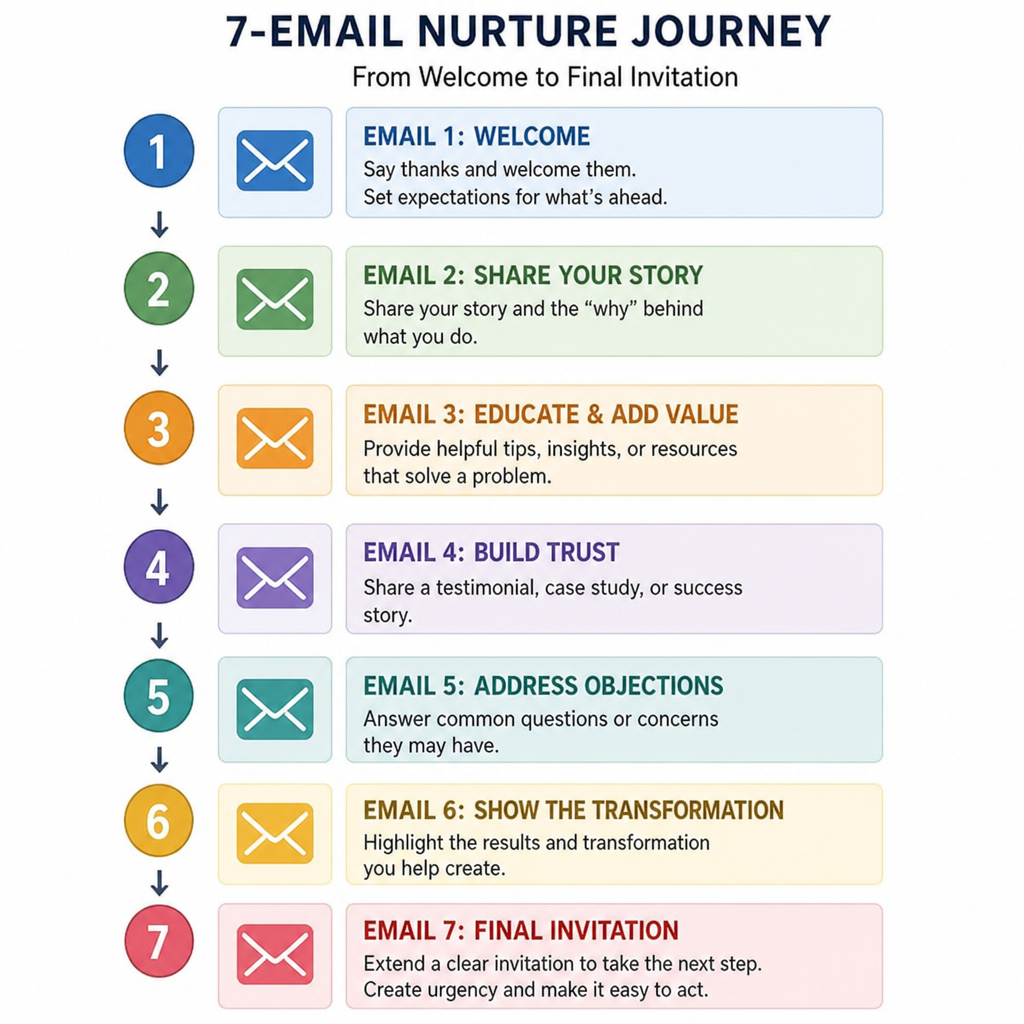
A coaching nurture sequence commonly includes five to seven emails, but the right length depends on the lead source, offer complexity, and decision required. A low-friction invitation may need only a short sequence, while a higher-commitment coaching program may need more education, reassurance, and objection handling.
Rather than chasing a perfect number, plan the minimum number of emails needed to help the lead make a better decision. If each message has a clear purpose, the sequence can be concise and effective. If emails repeat the same point, the sequence will feel long even when it is short.
A practical starting sequence is:
- Email 1: Welcome and deliver the promised value.
- Email 2: Clarify the core problem or opportunity.
- Email 3: Share one useful coaching insight.
- Email 4: Reframe a limiting belief or objection.
- Email 5: Explain your coaching approach or process.
- Email 6: Invite the lead to the next step.
- Email 7: Send a thoughtful reminder or final prompt.
You can shorten or expand this based on engagement. If people reply early, the sequence is doing its job. If they disengage, review relevance, subject lines, and whether the CTA matches their readiness.
7. Write subject lines that match the email’s promise
Subject lines should create curiosity without misleading the reader. For coaching leads, the best subject lines often speak to a recognizable tension, a desired outcome, or a reflective question. They should sound like a continuation of the conversation, not a gimmick.
Keep subject lines specific and honest. A subject line such as “A better way to handle career uncertainty” sets a clearer expectation than “You need to read this.” If your coaching brand is warm and reflective, let the subject line feel warm and reflective. If your brand is strategic and direct, make it crisp.
Try these subject line angles:
- Problem-aware: “Why clarity feels hard right now”
- Insight-based: “The pattern that keeps showing up”
- Reflective: “What would change if this felt simpler?”
- Process-focused: “What happens on a coaching call”
- Invitation-led: “Ready to talk through your next step?”
The subject line and email body should agree. If the subject promises a practical insight, deliver one. If it invites a decision, make the next action clear.
8. Add CTAs that feel like guidance, not pressure
A call to action in a coaching email should feel aligned with the reader’s next best step. Early in the sequence, the CTA might be a reply or a reflection prompt. Later, it can become more direct, such as booking a call or completing an application.
Use one primary CTA per email whenever possible. Multiple competing links can dilute action, especially when the lead is already uncertain. Make the CTA visible, specific, and connected to the benefit of taking the next step.
Examples include:
- “Reply and tell me where you feel most stuck right now.”
- “Book a consultation if you want support mapping your next move.”
- “Read the coaching approach page to see whether this feels aligned.”
- “Apply here if you are ready for structured support.”
- “Save this prompt and use it before your next decision.”
Do not hide the invitation. If your sequence has provided value and context, a clear CTA is not pushy. It is helpful direction.

9. Automate the sequence and personalize where it matters
Once the emails are written, build the automation in your email platform. Set the trigger based on the lead’s action, such as downloading a guide, registering for a workshop, or submitting a form. Then space the messages so the reader has time to engage without forgetting who you are.
Personalization does not need to be complicated. Use the lead’s first name if collected reliably, reference the resource they requested, and segment by interest when possible. More importantly, personalize the relevance of the content. A highly relevant email feels personal even without advanced automation.
Before publishing, check:
- Trigger: Does the sequence start after the correct action?
- Timing: Are emails spaced in a way that feels natural?
- Links: Do all CTAs lead to the right page or calendar?
- Tags: Are leads segmented by source or interest?
- Exit rules: Should someone leave the sequence after booking or applying?
- Mobile display: Are paragraphs short and easy to read?
- Compliance basics: Do emails include required unsubscribe and sender details?
Test the sequence yourself before sending traffic into it. A broken link or confusing trigger can interrupt an otherwise strong nurture experience.
10. Measure, refine, and improve your lead nurturing emails
After launch, review how people interact with the sequence. Look for patterns: which subject lines get opened, which CTAs get clicks, which emails receive replies, and where engagement drops. Use these signals to improve clarity and relevance.
Avoid changing everything at once. If you rewrite subject lines, keep the body stable. If you change the CTA, keep the timing stable. This helps you understand what actually made a difference.
Refine in this order:
- Relevance: Does the sequence match the opt-in promise?
- Clarity: Does each email have one main idea?
- CTA fit: Is the ask appropriate for the lead’s readiness?
- Timing: Are emails too close together or too spread out?
- Objection handling: Are you addressing the real reasons people hesitate?
- Offer alignment: Does the sequence naturally lead to your coaching offer?
Improvement is part of the system. Your first version gives you a baseline; your next version gets sharper because it is based on real behavior.
Frequently Asked Questions
Quick answers to the most common questions about this topic.
Get welcome sequences, nurture flows, tagging, and automated follow-up built so your email list turns into paying clients on autopilot. done-for-you email marketing system.
Related Articles
What Emails Should a Coach Send to Their Email List?
Exactly what emails a coach should send to their email list to build trust, engage subscribers, and boost re-engagement, using effective email marketing strategies.
Email MarketingHow to Build an Email List for Your Coaching Business
Email list building for coaching business growth starts with a clear offer, a simple signup path, and consistent email marketing coaching that turns subscribers into warm prospects.
Email MarketingHow Many Emails Should You Send After Someone Downloads a Lead Magnet?
A good lead magnet email follow-up usually includes five to seven emails sent over about one to two weeks. Learn optimal email marketing tactics for balanced engagement and conversion.