
Adding funnel services to social media management means moving beyond posting, scheduling, and engagement to help clients turn attention into measurable leads, booked calls, sales, or other conversions. The goal is not to replace social strategy; it is to connect content, automation, landing pages, lead magnets, email follow-up, and reporting into one clear customer journey. This guide walks you through how to package, build, and sell funnel services in a practical way without overcomplicating your offer.
What changes when you add funnel services to social media management?
When you add funnel services, your role shifts from managing visibility to managing the path from awareness to action. Traditional social media management often focuses on content calendars, community engagement, brand consistency, and audience growth. Funnel services add the next layer: what happens after someone clicks, signs up, downloads, replies, books, or buys.
This matters because many businesses already have social activity but no reliable conversion path. They may post consistently and still lose prospects because there is no lead capture, no follow-up sequence, no segmented offer, or no performance tracking beyond likes and reach. Funnel services for social media management give you a stronger value proposition because you can connect content to business outcomes.
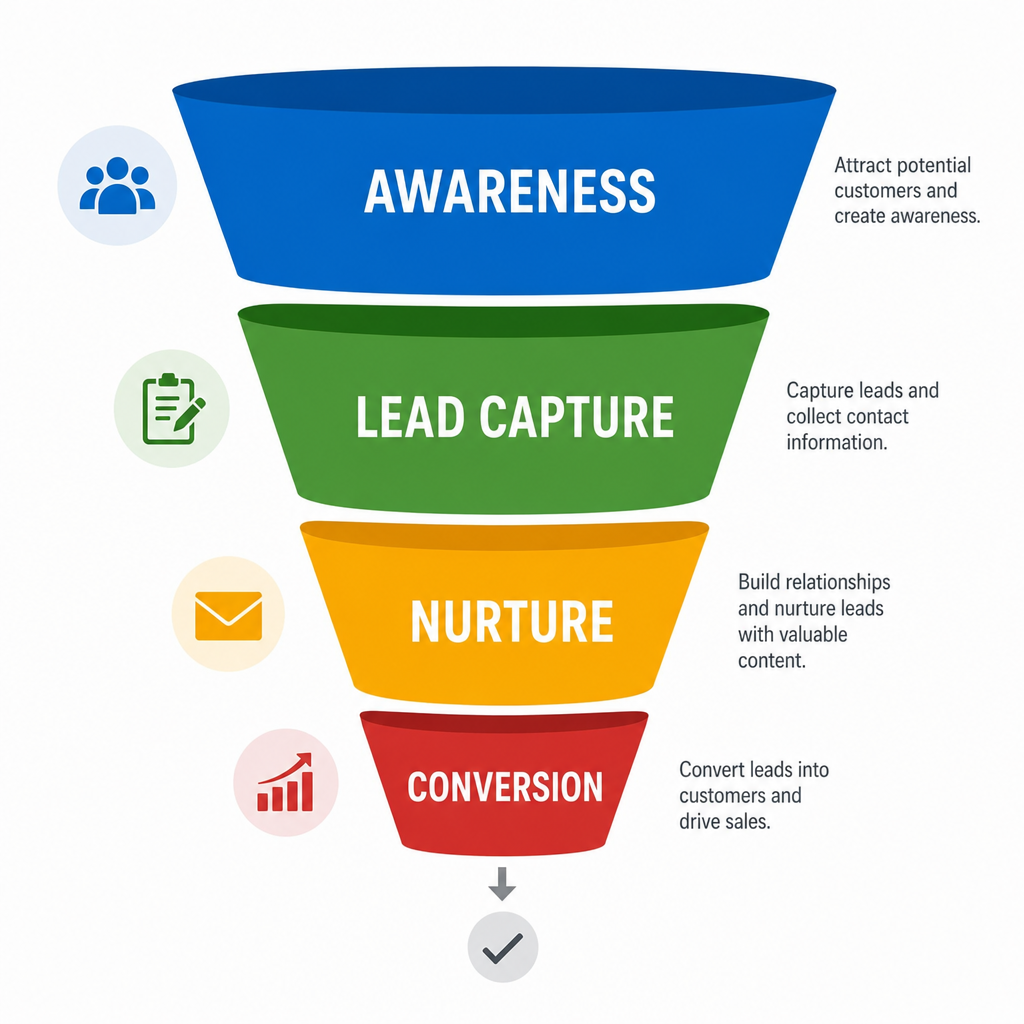
Funnel diagram illustrating the customer journey from Awareness to Lead Capture, Nurture, and Conversion.
Define the outcome before building the funnel
Start by identifying the specific result the funnel should produce. A funnel built to generate consultation calls will look different from one designed to sell a low-ticket digital product, grow an email list, fill a webinar, or nurture local service leads. If you skip this step, you risk building assets that look professional but do not guide the audience toward a clear next action.
Choose one primary conversion goal for the first funnel. This keeps the campaign focused and makes reporting easier. For example, a fitness coach may want discovery calls, while an ecommerce brand may want first-time purchases from a social campaign. Both need social media content, but their funnel steps, messaging, incentives, and follow-up will differ.
Use these questions to define the outcome:
- What action should the audience take? Examples include downloading a guide, booking a call, joining a waitlist, registering for an event, or making a purchase.
- Who is the funnel for? Define the audience by pain point, buying stage, and level of awareness, not only by demographics.
- What offer moves them forward? The offer should feel like a logical next step from the content they already engage with.
- How will success be measured? Decide whether you are tracking leads, bookings, purchases, email opt-ins, conversion rate, or revenue.
Once the outcome is clear, every post, landing page, automation, and follow-up message has a job. That clarity is what makes funnel services more strategic than simply adding a few links to social posts.
Audit the client’s current social and conversion assets
Before creating new funnel assets, review what the client already has. Many businesses have useful pieces scattered across their marketing system: an old lead magnet, an email list, a booking page, a product page, testimonials, a customer FAQ, or social posts that performed well. Your job is to identify what can be used, what must be improved, and what is missing.
Look at the social media management side first. Which platforms are active? Which posts generate saves, comments, shares, clicks, or direct messages? Which topics consistently attract the right audience? These signals help you understand what the market already responds to.
Then review the conversion path. Click through the link in bio, campaign links, landing pages, forms, checkout pages, and booking tools. Notice where the experience becomes unclear. A common problem is a strong social post leading to a generic homepage with too many choices. Another is a lead form with no automated follow-up, leaving interested prospects waiting.
A simple audit checklist should include:
- Active social platforms and their main role in the buyer journey
- Best-performing content themes and calls to action
- Current link-in-bio or profile link structure
- Existing lead magnets, offers, or landing pages
- Email marketing platform or CRM access
- Booking, checkout, or inquiry process
- Tracking tools, pixels, UTMs, or analytics setup
- Gaps in messaging, follow-up, or conversion reporting
This audit helps you avoid selling unnecessary work. It also gives you a practical basis for recommending the right funnel package.
Select the right funnel type for the client’s offer
Not every client needs a complex funnel. The best funnel is the simplest one that matches the audience, offer, and sales process. For social media management clients, the funnel should feel like a natural extension of the content they are already publishing.
A service business may benefit from a lead magnet funnel that captures email addresses and nurtures prospects toward a consultation. A coach or consultant may use a quiz, checklist, webinar, or booking funnel. An ecommerce business may need a product-focused funnel with a first-purchase offer, abandoned cart follow-up, and retargeting content. A local business may need a direct inquiry funnel with social proof, location-specific messaging, and a fast contact method.
Common funnel types include:
- Lead magnet funnel: Best for educating prospects and building an owned audience. The user exchanges an email address for a guide, checklist, template, coupon, or resource.
- Booking funnel: Best for consultants, agencies, clinics, coaches, and service providers. The funnel moves users from social proof or educational content to a calendar or inquiry form.
- Webinar or event funnel: Best for offers that require explanation, trust, or demonstration before purchase.
- Product sales funnel: Best for ecommerce or digital products. It often includes a social ad or organic post, product page, incentive, checkout, and follow-up.
- DM funnel: Best when conversations are part of the sales process. Social media automation can help route replies, deliver resources, and prompt qualified users to take the next step.
Avoid choosing a funnel because it sounds advanced. Choose it because it reduces friction between the audience’s current interest and the client’s business goal.
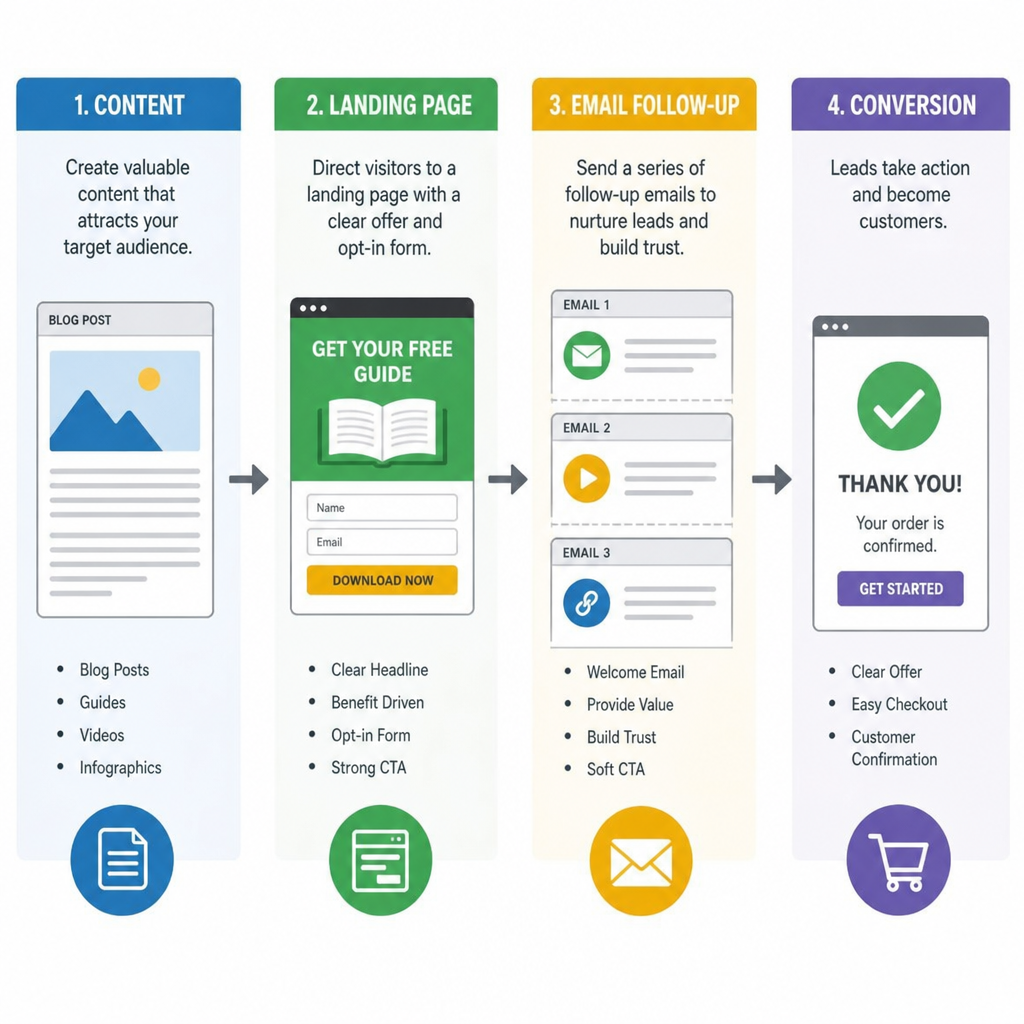
Funnel workflow overview mapping Content creation to Landing Page capture, Email follow-up, and final Conversion.
Build the core funnel path step by step
A funnel does not need dozens of assets to work. Start with a clear core path, then improve it over time. The following sequence gives you a practical framework for adding funnel services to your social media management process.
1. Map the audience journey
Identify what the audience already knows, what they are struggling with, and what would make them trust the next step. Social content usually handles awareness and interest, while the funnel handles lead capture, nurture, and conversion. Mapping this journey prevents mismatched messaging, such as sending a cold audience directly to a high-commitment sales page without education or context.
2. Create or refine the entry offer
The entry offer is the reason someone leaves the social platform and enters the funnel. It might be a free checklist, discount, quiz result, webinar seat, consultation, resource library, or starter product. Make it specific and useful. A vague “sign up for updates” offer is rarely as compelling as a resource that solves one clear problem.
3. Write the social call to action
Your social CTA should match the platform and the user’s level of intent. A caption might invite people to comment a keyword, click the profile link, send a direct message, or register through a landing page. Keep the CTA direct, but not pushy. The user should understand exactly what they get and what happens next.
4. Build a focused landing page
The landing page should support one action. Include a clear headline, concise explanation, relevant benefits, trust elements where available, and a simple form or button. Remove distractions that compete with the primary goal. If the page is for lead capture, do not overload it with every service the client offers.
5. Connect the form, CRM, or email platform
Once someone opts in, their information should be captured correctly and sent to the right system. Tag or segment leads based on the funnel source, offer, or campaign where possible. This makes future follow-up more relevant and helps you report on performance accurately.
6. Create the follow-up sequence
The first follow-up should deliver what was promised immediately. After that, use a short nurture sequence to educate, answer objections, build trust, and invite the next action. Keep the sequence aligned with the original offer. If someone downloaded a beginner checklist, do not send them straight into an aggressive sales pitch without context.
7. Add social media automation where it improves speed
Social media automation can support the funnel by sending resources through direct messages, routing inquiries, reminding users about events, or triggering follow-up actions. Use automation to reduce manual work and improve response time, not to create a cold or confusing experience. Always review platform rules and make sure users understand what they are opting into.
8. Track the user path
Use tracking links, analytics, platform insights, and CRM data to understand what is happening. At minimum, track the source of traffic, landing page conversion rate, lead quality, and final action. This helps you show clients that social media management is contributing to measurable movement, not just content output.
9. Review and improve the funnel
After launch, look for the weakest point in the journey. If many people click but few opt in, the landing page or offer may need work. If many leads opt in but few book, the follow-up or qualification process may be unclear. Optimization should be ongoing, but changes should be intentional rather than constant.
Package funnel services as a clear offer
Clients are more likely to buy when they understand what is included, why it matters, and how it fits with their current social media management. Instead of presenting “funnels” as a vague add-on, package the service around outcomes and deliverables.
You can offer funnel services as a one-time setup, a monthly optimization service, or a premium tier inside your existing social media package. The right model depends on your capacity and the client’s needs. A one-time build may work for clients who need a foundational funnel. Ongoing support is better when you are also creating content, managing campaigns, testing CTAs, and reviewing conversion data.
A basic funnel services package might include:
- Funnel strategy and customer journey map
- Lead magnet or entry offer guidance
- Landing page copy and structure
- Form, email, or CRM integration coordination
- Short nurture email sequence
- Social media CTA plan
- Basic tracking recommendations
- Monthly performance review
A more advanced package might also include campaign planning, DM automation flows, retargeting content, segmentation strategy, A/B testing recommendations, or sales handoff support. Be clear about what you do and do not handle. For example, if you do not build pages inside a specific platform, say whether you provide copy, wireframes, implementation guidance, or full setup.
Align content pillars with funnel stages
Funnel services work best when the social content supports the journey instead of existing separately from it. Your content pillars should guide people through awareness, consideration, and action. This makes your regular posting more strategic and helps the audience feel ready before they reach the landing page or booking form.
Awareness content should name problems, educate, and attract the right audience. Consideration content should build trust by explaining methods, showing process, answering objections, or highlighting results where the client has approved proof. Action content should invite a specific next step, such as downloading a resource, joining a waitlist, booking a consultation, or replying with a keyword.
A practical content mix could include:
- Problem-aware posts that help users recognize a challenge they want solved.
- Educational posts that teach one useful concept and position the client as helpful.
- Proof-based posts that use testimonials, examples, case studies, or process details when available.
- Objection-handling posts that address hesitation, timing, cost concerns, effort, or confusion.
- Conversion posts that clearly promote the funnel entry offer.
This approach also makes social media automation more relevant. If a user comments on a conversion post, an automated DM can deliver the promised resource. If they engage with consideration content, they may be invited to a lower-friction next step rather than a hard sell.
Set up automation without making the experience feel robotic
Automation should support human decision-making, not replace it entirely. The best social media automation feels timely, helpful, and easy to understand. The worst automation feels intrusive, repetitive, or disconnected from what the user actually asked for.
Use automation in places where speed and consistency matter. For example, you can automatically send a lead magnet link when someone comments a keyword, confirm registration after a form submission, or notify the client when a qualified lead requests a call. You can also use automation to tag leads by source so follow-up content is more relevant.
Before launching automation, test the full experience from the user’s perspective. Comment on the post, open the message, click the link, submit the form, check the email, and confirm the data appears where it should. Small errors can break trust quickly. A misspelled name field, broken link, duplicate message, or delayed delivery can reduce conversions even if the strategy is strong.
Keep these automation safeguards in place:
- Make opt-in language clear and honest.
- Avoid sending too many messages too quickly.
- Give users a simple way to stop or change communication where applicable.
- Monitor replies so real questions receive human attention.
- Review platform policies before using automated comments, messages, or engagement tools.
- Keep message tone aligned with the client’s brand.
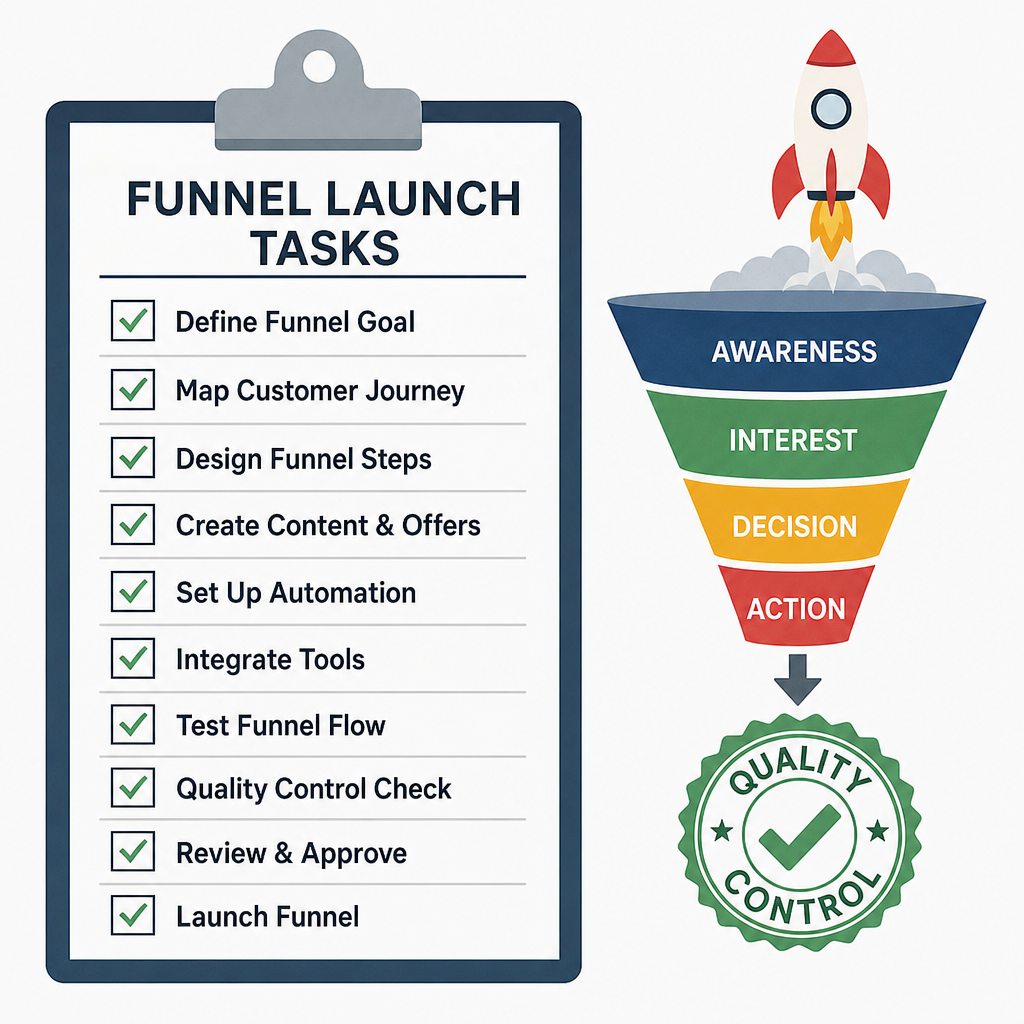
Funnel launch checklist outlining steps for defining goals, designing steps, testing flow, and quality control.
Create reporting that connects social activity to conversions
Reporting is one of the strongest reasons to add funnel services for social media management. Standard social reports often show reach, impressions, engagement, follower growth, and top posts. Those metrics are useful, but funnel reporting explains what those activities produced after the click or conversation.
Your report should show the relationship between content, traffic, leads, and conversions. You do not need to overwhelm the client with every metric. Focus on a small set of numbers that match the funnel goal and help guide decisions.
Include metrics such as:
- Social post or campaign clicks
- Landing page visits
- Opt-in or form submission rate
- Number of new leads
- Email open and click activity, when available
- Booked calls, purchases, inquiries, or registrations
- Lead source or campaign source
- Drop-off points in the funnel
- Recommended next actions
The most important part of reporting is interpretation. Do not simply list numbers. Explain what they suggest and what you recommend changing. For example, if clicks are high but sign-ups are low, you may test a stronger landing page headline or simplify the form. If leads are strong but bookings are weak, you may improve the nurture sequence or clarify the consultation offer.
Price and position the service with confidence
Funnel services add strategic and technical value, so they should not be treated as a small bonus inside a standard posting package. You are helping the client connect content to a measurable business pathway. That requires planning, copy, systems, testing, and ongoing judgment.
When positioning the service, focus on the business problem it solves. Many clients do not wake up thinking they need a funnel. They know they need more qualified leads, better follow-up, more useful reporting, or a clearer path from social engagement to sales. Translate your service into those terms.
Your proposal can frame the value this way:
- Social content attracts and educates the audience.
- The funnel captures interest before it disappears.
- Follow-up nurtures prospects after the first interaction.
- Automation improves speed and consistency.
- Reporting shows which activities are moving people toward conversion.
Be careful not to promise guaranteed results. Instead, describe the system you will build, the decisions it will support, and the improvements you will monitor. This keeps the offer credible while still making the value clear.
Launch with a simple rollout plan
A successful funnel launch does not need to be overwhelming. Break it into phases so both you and the client know what is happening. This also helps manage expectations because funnel services often involve approvals, platform access, creative assets, and technical setup.
Use a rollout plan like this:
Week one: Strategy and audit
Confirm the goal, review existing assets, define the audience, and choose the funnel type. Gather access to social accounts, landing page tools, email platforms, analytics, and any brand materials needed.
Week two: Offer and asset creation
Develop the lead magnet or entry offer, draft landing page copy, write calls to action, and outline the follow-up sequence. Keep approvals organized so the project does not stall.
Week three: Build and connect systems
Build or coordinate the landing page, connect forms, set up tags or lists, load emails, and configure any social media automation. Test every step before promoting the funnel.
Week four: Promote and monitor
Publish social content that drives traffic to the funnel. Watch early performance closely so you can catch broken links, unclear messaging, or drop-off points quickly.
Ongoing: Optimize and report
Review results, identify the biggest bottleneck, and make focused improvements. Continue aligning the content calendar with the funnel goal.
This phased approach makes the service easier to sell and easier to deliver. It also gives the client confidence because they can see a clear process instead of a vague promise.
Avoid common mistakes that weaken funnel performance
The most common mistake is building too much too soon. A complex funnel with multiple offers, long automations, and unclear segmentation can create more confusion than conversion. Start with one audience, one entry offer, and one primary action.
Another mistake is treating the funnel as separate from social content. If the posts do not prepare the audience for the offer, the landing page has to do too much work. The content calendar should warm up the audience, answer objections, and make the CTA feel relevant.
Also avoid weak follow-up. Many campaigns focus heavily on the opt-in but neglect what happens afterward. If the lead receives one generic email and then nothing, the funnel is incomplete. The follow-up is where trust deepens and the next action becomes easier.
Finally, do not ignore lead quality. A funnel that generates many unqualified contacts may look successful at first but disappoint the client later. Use clearer messaging, better qualification questions, or more specific offers to attract people who are more likely to become customers.
Use this checklist before offering funnel services
Before you add funnel services to your social media management packages, make sure you can deliver a reliable process. You do not need to master every advanced tool, but you do need a clear framework, defined deliverables, and a method for measuring outcomes.
Use this readiness checklist:
- You can explain the difference between social engagement and funnel conversion.
- You know how to map a simple customer journey.
- You can identify a relevant lead magnet or entry offer.
- You can write or guide landing page copy focused on one action.
- You understand basic email follow-up structure.
- You can coordinate or implement form, CRM, or email platform connections.
- You can use tracking links or analytics to review performance.
- You can explain results in plain language to clients.
- You have a clear scope for what is included and what costs extra.
If several items feel uncertain, start with a smaller funnel add-on. For example, offer a lead capture audit, a CTA improvement plan, or a landing page and follow-up sequence before selling a larger automation package.
Turn your social media service into a conversion system
Adding funnel services is one of the most practical ways to increase the value of social media management. It helps clients understand what their content is doing, gives prospects a clearer next step, and creates a system that can be improved over time.
Start with a simple offer, a focused landing page, a short follow-up sequence, and basic reporting. Once that foundation works, you can add more advanced segmentation, automation, testing, and campaign planning. If you already manage social content for clients, funnel services are a natural next step because they connect your daily work to the outcomes clients care about most.
Frequently Asked Questions
Quick answers to the most common questions about this topic.
Ready to Add Funnel Services to Your Social Media Management?
Explore our backend white-label systems and partnerships to help your social media clients convert attention into qualified leads and sales.
Explore White-Label Partner Services →