
Social media can create attention, trust, and visibility, but attention is not the same as a lead. For coaches and service providers, the gap usually sits between the post and the next step: unclear CTAs, weak landing pages, no lead magnet, poor tracking, or inconsistent follow-up. This article breaks down why your social media traffic isn't converting into leads and how to turn casual clicks into measurable opportunities inside a simple coaching system.
Why isn't your social media traffic turning into leads?
Your social media traffic is not turning into leads because the journey after the click is either unclear, untracked, or not valuable enough to earn contact information. A post may get views, comments, saves, and profile visits, but if people do not know exactly what to do next, or the next step feels too vague, they leave without entering your pipeline. Strong social media traffic conversion depends on a connected path: relevant content, a specific CTA, a focused landing page, a useful lead magnet, CRM capture, and timely follow-up.
Many coaches think they have a traffic problem when they really have a conversion system problem. More reels, carousels, stories, and posts will not fix a broken handoff. If the audience is interested but the offer is hidden behind "DM me" instructions, a cluttered bio link, or a generic website homepage, the conversion rate will stay inconsistent.
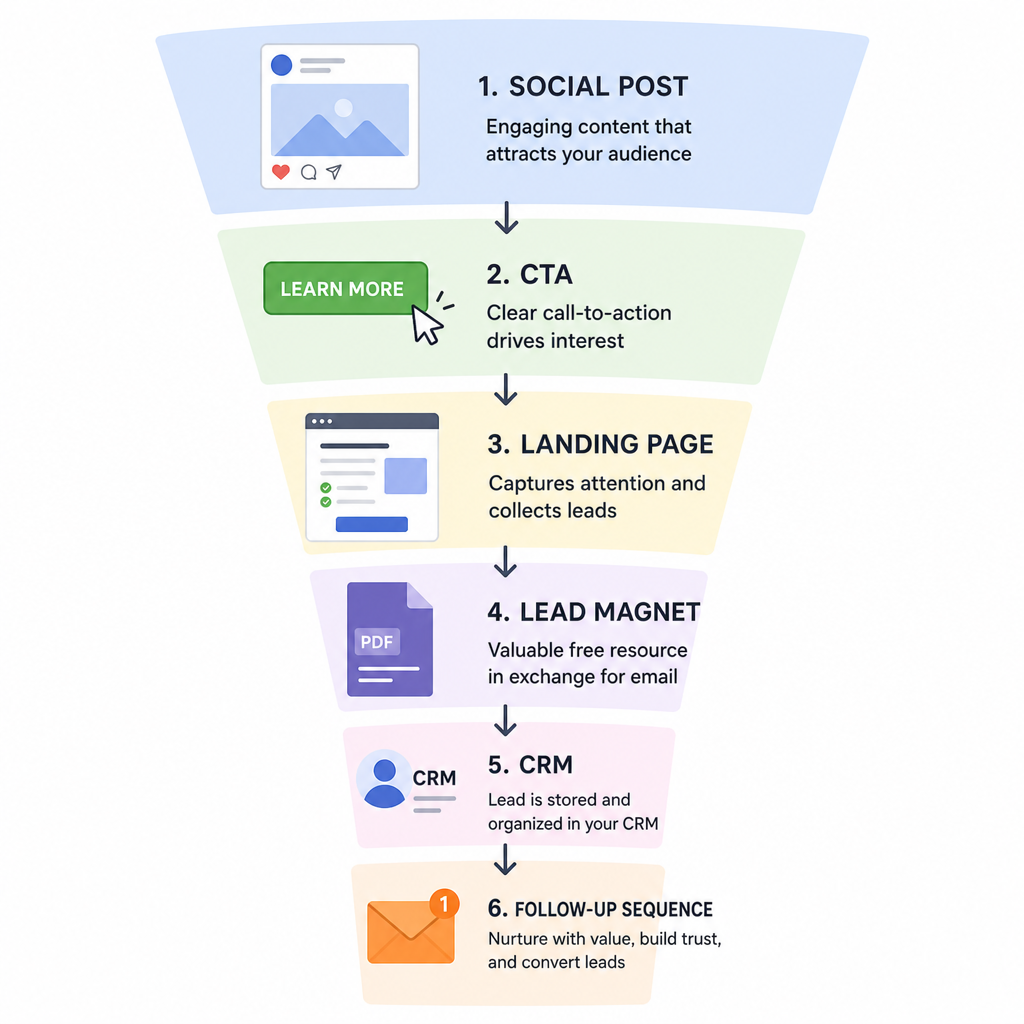
The complete social media traffic conversion path: content, CTA, landing page, lead magnet, CRM, and follow-up sequence.
Visibility without a conversion path creates vanity metrics
Social media marketing is excellent for warming up an audience. It helps people understand your ideas, see your personality, and decide whether your approach feels relevant to them. But reach and engagement are early signals, not business outcomes by themselves.
For coaches, consultants, and service providers, the real question is not “Did this post perform?” It is “Did this post move the right person closer to a measurable next step?” That next step might be downloading a guide, registering for a workshop, booking a call, taking an assessment, or joining an email sequence.
A stronger social media strategy for coaches connects content themes to conversion goals. Educational posts can point to a lead magnet. Case-style posts can point to a consultation. Behind-the-scenes posts can build trust before inviting people into a webinar or application. The goal is not to make every post sales-heavy, but to ensure your best traffic has somewhere useful to go.
The most common leaks in a social traffic funnel
A social traffic funnel does not need to be complicated, but it does need to be intentional. If even one step is vague, the whole system can leak. Most conversion issues come from one of these points:
- The audience is too broad. Your content attracts attention, but not from people who are likely to buy coaching, consulting, or professional services.
- The CTA is unclear. People enjoy the post but do not know whether they should click, comment, download, book, or reply.
- The landing page is doing too much. It tries to explain every offer, every credential, and every service instead of focusing on one action.
- The lead magnet lacks urgency. The free resource is not specific enough to solve a real problem or create a meaningful quick win.
- The CRM is disconnected. Leads arrive through DMs, forms, email, and calendar links, but they are not captured in one trackable place.
- Follow-up is slow or inconsistent. Interested people go cold because there is no planned email sequence, reminder, or personal outreach process.
- Social media ROI is not measured. Content performance is tracked, but lead source, conversion rate, and booked-call quality are not.
These leaks are fixable. Scalable Coaching Systems thinking starts with the belief that growth should not depend on guessing, chasing, or manually remembering who needs a follow-up. The system should make the next step obvious for the prospect and visible for the business owner.
What should your CTA ask people to do?
Your CTA should ask people to take one clear action that matches their level of awareness and the purpose of the content. A first-time viewer may be ready to download a checklist, while a warm follower may be ready to book a call or attend a training. The best CTAs are specific, low-friction, and directly connected to the problem discussed in the post.
A weak CTA says, “Reach out if you need help.” A stronger CTA says, “Download the 10-minute intake audit to find the gaps in your coaching funnel.” The second option is clearer because it names the action, the resource, and the outcome.
Use different CTA types across your content mix:
- Engagement CTAs for early trust building: “Comment ‘plan’ and I’ll send the checklist.”
- Traffic CTAs for moving people off-platform: “Get the free guide through the link in bio.”
- Lead CTAs for list building: “Download the worksheet and receive the follow-up template.”
- Sales CTAs for warmer prospects: “Book a strategy call if you want help building this system.”
- Nurture CTAs for people not ready yet: “Join the email series for weekly conversion tips.”
The mistake is using only one CTA for every situation. If all roads lead to a discovery call, colder prospects may hesitate. If all roads lead to free content, warmer prospects may never be invited to take a serious next step.
Landing pages turn interest into commitment
Sending social traffic to a homepage often creates friction. A homepage usually has multiple menus, several messages, and many possible exits. A landing page has one job: help the visitor understand the value of the next step and complete it.
For leads from social media, the landing page should feel like a continuation of the post they clicked from. If the post discusses inconsistent discovery calls, the landing page should not open with a broad brand story. It should confirm the pain, introduce the resource or offer, explain who it is for, and make the form easy to complete.
A high-converting landing page for coaches usually includes:
- A headline that names the problem or desired result.
- A short explanation of what the visitor receives.
- Three to five bullets showing practical benefits.
- A simple form asking only for necessary information.
- A clear button with action-focused language.
- Trust-building details, such as who the resource is for or how it helps.
- A next-step message after submission, so the lead knows what happens next.
Avoid asking for too much too soon. If the offer is a free checklist, name and email may be enough. If the offer is an application for a high-touch coaching program, more detail may be appropriate. The form should match the commitment level.
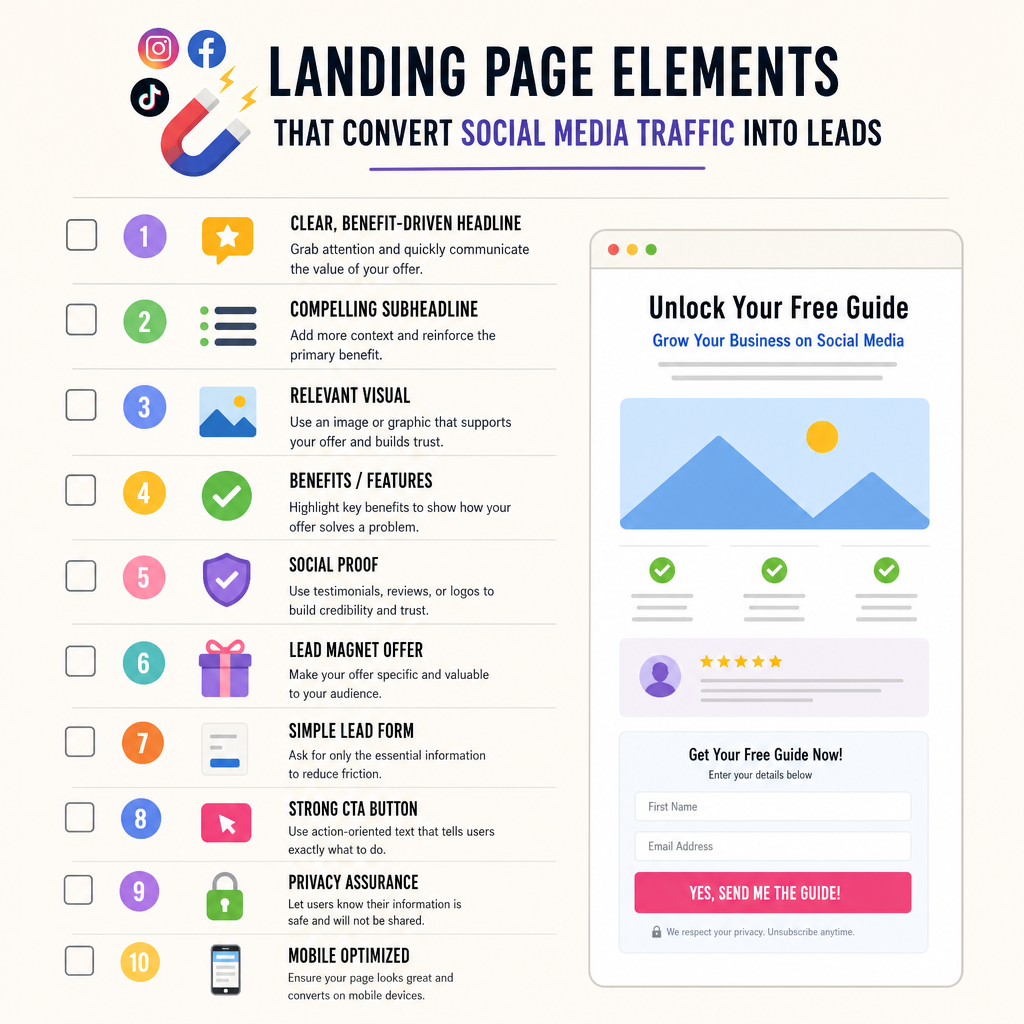
Essential landing page elements required to convert social media visitors into high-quality coaching leads.
A better lead magnet makes the exchange feel worthwhile
A lead magnet works when the visitor believes the resource will help them solve a specific problem faster than they could alone. It does not need to be long, complex, or beautifully designed to convert. It needs to be relevant, useful, and connected to the next paid step.
For coaches and service providers, effective lead magnets often include:
- A diagnostic checklist that helps prospects identify what is broken.
- A short workbook that helps them clarify goals or decisions.
- A calculator or scorecard that gives them a personalized result.
- A swipe file or template that saves time.
- A short training that explains your method and frames the next step.
- A readiness assessment that segments leads by need or urgency.
The strongest lead magnets create a natural bridge to your offer. If you sell coaching around client acquisition, a “30 social post ideas” PDF may attract people who want content help, but a “lead flow audit” may attract people who want a better business development system. That difference matters.
Do not treat the lead magnet as a random freebie. Treat it as the first structured experience a prospect has with your process.
Trackable systems reveal what is actually working
If you cannot see where leads come from, you cannot improve social media roi with confidence. You may know that people are clicking, but not which post, platform, CTA, or lead magnet produces qualified conversations. That makes decisions emotional instead of operational.
A basic tracking setup does not need to be overwhelming. Start with simple source labels and consistent naming. Use unique landing pages or tagged links for major campaigns. Ask new leads how they found you if your forms or CRM allow it. Review results weekly or monthly, not randomly when a post performs well.
A practical tracking flow looks like this:
- A social post points to one specific CTA.
- The CTA sends traffic to a matching landing page.
- The landing page form adds the person to your CRM.
- The CRM records the source, resource, and date.
- The lead receives an automated follow-up sequence.
- Warm leads are tagged for personal outreach or sales conversation.
- Results are reviewed by platform, offer, and lead quality.
You can also support measurement with tools such as Google Analytics, platform analytics, CRM reporting, and tagged campaign links. For internal SEO and user experience, link related resources together, such as your guides on lead magnets, coaching funnels, and CRM follow-up systems.
Follow-up converts the leads your content creates
Getting the email address or form submission is not the finish line. It is the beginning of the relationship. Many social leads are interested but not ready to buy on the same day they opt in, especially if they are evaluating coaching, consulting, or a higher-trust service.
Your follow-up should remind them why they opted in, help them use the resource, and invite them toward the next logical step. This is where a CRM becomes more than a digital contact list. It lets you segment leads, trigger emails, track conversations, and avoid losing warm opportunities in your inbox.
A simple follow-up sequence might include:
- Email 1: Deliver the resource and explain how to use it.
- Email 2: Name the common problem the resource helps reveal.
- Email 3: Share a practical tip or framework related to the issue.
- Email 4: Invite the lead to book a call, attend a training, or reply with a question.
- Email 5: Offer a next step for people who are not ready yet, such as staying on the newsletter.
Personal follow-up can also be valuable, especially when someone completes an assessment, comments repeatedly, or visits a booking page. The key is to make outreach helpful, not pushy. Reference the action they took and offer a relevant next step.
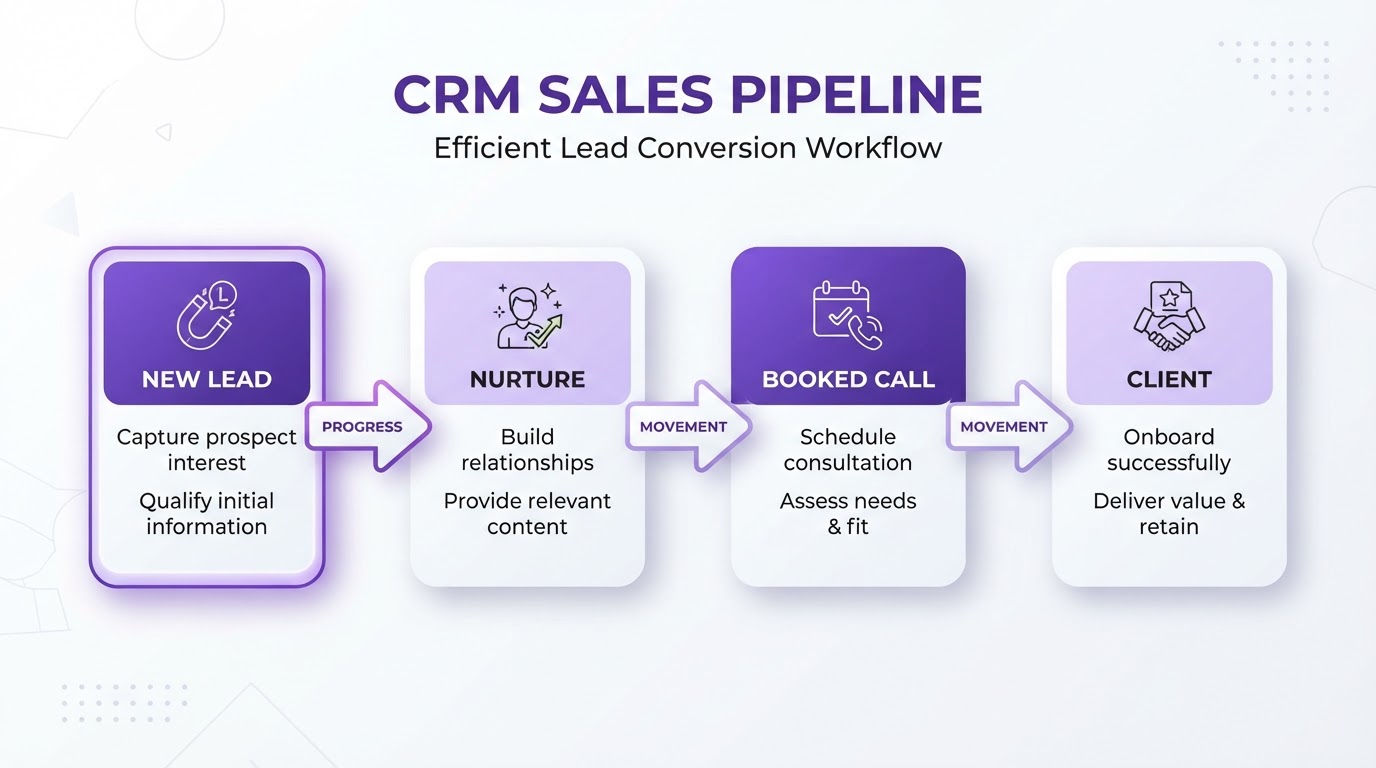
CRM pipeline progression tracking prospects from initial lead capture through nurture, booked call, and client conversion.
Build a content-to-lead system instead of posting harder
More content is not always the answer. Better alignment is. When your social media marketing connects to a clear offer pathway, each post has a role inside the larger system.
Start by mapping your content around buyer awareness:
- Problem-aware content: Helps people name what is not working, such as inconsistent leads or low conversion.
- Solution-aware content: Explains the systems that solve the problem, such as lead magnets, landing pages, CRM, and follow-up.
- Method-aware content: Shows how your approach organizes the moving pieces.
- Decision-stage content: Answers objections, clarifies fit, and invites a direct next step.
This structure prevents your feed from becoming a random collection of tips. It also helps your audience self-select. People who only want free inspiration can still learn from you, while serious prospects have a clear path into your pipeline.
Your social traffic conversion checklist
Use this checklist to find the weakest point in your current system:
- Is your ideal coaching or service client clearly reflected in your content?
- Does each conversion-focused post have one primary CTA?
- Does your bio or profile link point to a focused next step instead of a confusing menu?
- Does your landing page match the promise made in the post?
- Is your lead magnet specific enough to feel immediately useful?
- Are new leads automatically added to a CRM or organized contact system?
- Can you identify which platform, post, or campaign created the lead?
- Do new leads receive follow-up within a reasonable time frame?
- Are warm leads invited to book, apply, attend, or reply?
- Do you review lead quality, not just likes and clicks?
If you answer “no” to several of these, your issue is probably not visibility. It is the absence of a complete conversion pathway.
The takeaway
If your social media traffic is not converting into leads, do not assume your audience is not interested. They may simply need a clearer path. Coaches and service providers convert more traffic when content, CTAs, landing pages, lead magnets, CRM tracking, and follow-up work together.
Scalable Coaching Systems is the right mindset: build the path once, improve it with data, and stop relying on random posting momentum. When your social presence becomes part of a trackable lead system, every click has a better chance of becoming a real conversation.
Frequently Asked Questions
Quick answers to the most common questions about this topic.