What Emails Should a Coach Send to Their Email List?

Kara Leanne
Scalable Coaching Systems Expert · Updated August 31, 2026
Scalable Coaching Systems builds affordable, done-for-you email marketing systems for online coaches — so your list turns into paying clients on autopilot.
Get a Free Funnel Strategy →A healthy coaching email list does more than announce offers. It builds trust, teaches your approach, starts conversations, and gives the right people a clear path to work with you when they are ready. If you have ever asked, “What emails should a coach send to their email list?”, the best answer is a balanced mix of welcome emails, value-driven coaching emails, personal stories, social proof, invitations, sales emails, and re-engagement email campaigns for coaches.

What emails should coaches send first?
Coaches should send a welcome sequence first because new subscribers are paying the most attention right after they join your list. This is your opportunity to introduce who you help, what you believe, how your coaching works, and what kind of value they can expect from your emails. A strong welcome sequence makes future emails feel familiar instead of random.
Think of this first sequence as the beginning of a relationship, not a pitch deck. People may have joined your list after downloading a free resource, attending a webinar, reading a blog post, or following you on social media. They need context before they need an offer.
A simple welcome sequence might include:
- The delivery email: Send the free resource, checklist, replay, or promised next step immediately. Keep it clear and easy to access.
- The introduction email: Share who you are, who you help, and why your coaching approach matters.
- The belief-shift email: Challenge a common misconception your audience has about their problem.
- The quick-win email: Give one practical action they can take today.
- The invitation email: Invite them to explore your services, book a call, reply with a question, or read a related article.
This is where email marketing for coaches becomes more personal than standard newsletter marketing. Your subscribers are not just looking for information. They are often looking for clarity, confidence, accountability, or transformation. Your first few emails should help them feel seen.
The core email types every coach needs
Once the welcome sequence is complete, your ongoing email strategy should rotate through several types of messages. Sending only educational content can train your audience to consume without acting. Sending only promotional content can make your list feel like a sales channel instead of a relationship.
The strongest coaching emails usually include a mix of teaching, storytelling, proof, invitation, and reflection. Together, they help your readers understand their problem, trust your perspective, and see how your coaching could support them.
Educational emails that create useful insight
Educational emails help subscribers solve small parts of their bigger problem. These emails can explain a concept, break down a mistake, answer a common question, or offer a practical framework. For example, a career coach might write about how to prepare for a difficult conversation with a manager, while a health coach might explain how to make a habit easier to repeat.
The key is to avoid turning every email into a long lesson. A good coaching email usually focuses on one idea and one next step. If the topic is too broad, split it into a short series.
Useful educational email ideas include:
- “The mistake I see most clients make before they start”
- “One question to ask yourself before making this decision”
- “A simple framework for getting unstuck”
- “Why more information is not always the answer”
- “How to know when you are ready for support”
When you publish related blog posts, podcast episodes, or videos, link to them naturally inside these emails. This supports internal linking, improves content discovery, and gives subscribers a reason to spend more time with your brand.
Story-based emails that build connection
People hire coaches they trust. Story-based emails help create that trust because they show the person behind the business. These emails might include a client-inspired lesson, a personal reflection, a turning point in your own journey, or a behind-the-scenes look at how you think.
You do not need to overshare to be effective. The best stories are relevant to the reader’s challenge. If the story does not lead to a useful lesson, it may belong in a journal rather than an email campaign.
A simple story structure works well:
- Start with a relatable moment or tension.
- Explain what changed or what you noticed.
- Connect the insight to the reader’s situation.
- Offer one question, action, or invitation.
This style works especially well in email marketing coaching because coaching is built on perspective shifts. A story can make an abstract lesson feel real.
Proof emails that reduce hesitation
Proof emails help subscribers believe that change is possible. Depending on what you are allowed to share, proof may include testimonials, anonymized client patterns, case-study-style lessons, screenshots with permission, or your own professional observations.
Avoid inventing results or making promises you cannot support. Instead, focus on the process, the problem, and the kind of progress your work helps people create. If you do not have testimonials yet, you can still write proof-oriented emails by explaining what happens inside your coaching process and why each step matters.
For example, instead of saying, “My clients always double their confidence,” you might say, “Many people come to coaching thinking they need a perfect plan. In our sessions, we start by identifying the decision they are avoiding, then build the next action around what is actually within their control.”
How often should a coach email their list?
Most coaches should email consistently enough to stay remembered, but not so often that each message feels rushed or thin. For many coaching businesses, one thoughtful email per week is a practical rhythm, while active launch periods may require more frequent emails for a short time. The better question is not only “how often,” but “can I keep this cadence useful, relevant, and sustainable?”
Consistency matters because subscribers need repeated exposure before they understand your point of view. If they hear from you once every few months, they may forget why they joined your list. If they hear from you daily with weak content, they may tune out.
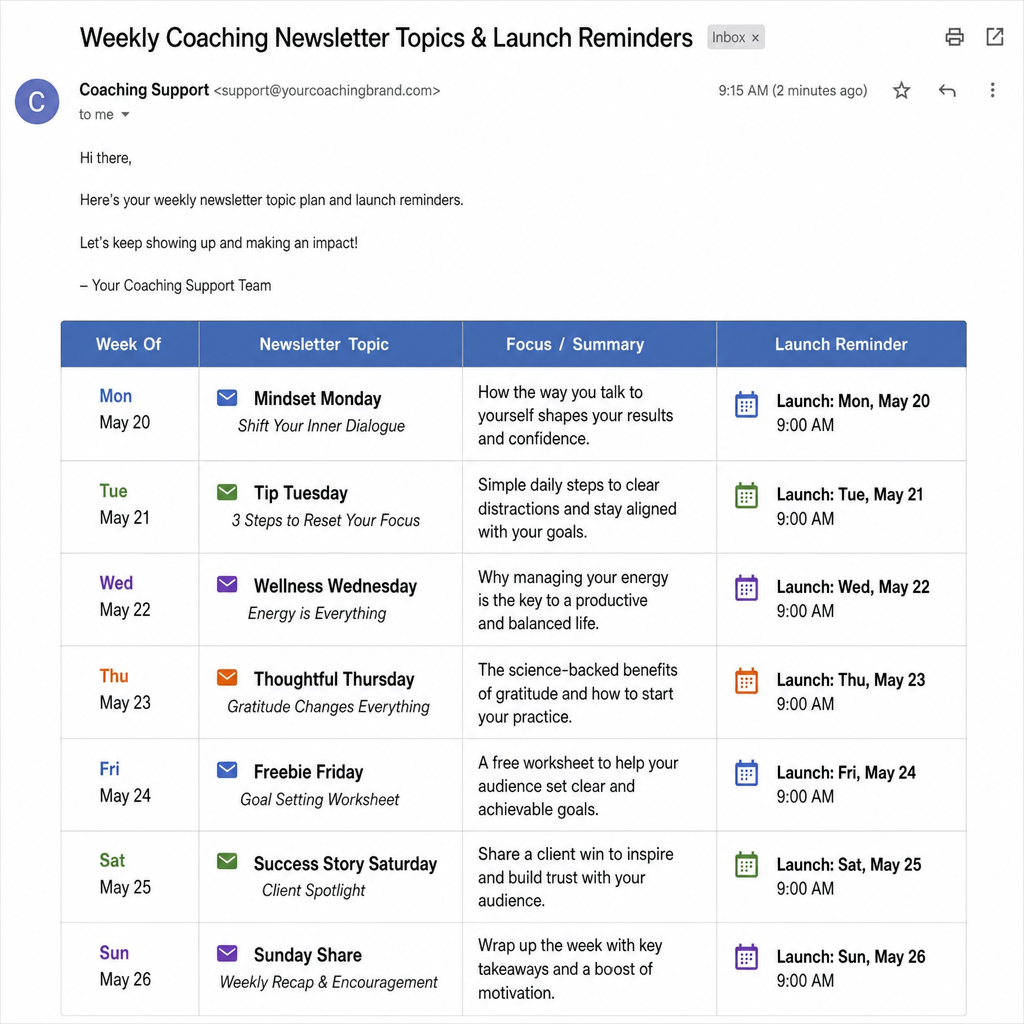
A realistic monthly rhythm could look like this:
- Week 1: Educational coaching email with a practical tip.
- Week 2: Personal story connected to a client challenge.
- Week 3: Proof, case-study lesson, or behind-the-scenes process email.
- Week 4: Invitation to book a call, join a workshop, read a service page, or reply.
During a promotion, you can temporarily increase the frequency. Just make sure each email has a different purpose. One email can announce the offer, another can explain who it is for, another can answer objections, and another can remind readers before the deadline.
Promotional emails without sounding pushy
Many coaches avoid sales emails because they do not want to pressure their audience. That is understandable, but avoiding invitations entirely can leave interested subscribers unsure how to work with you. Ethical promotion is not manipulation. It is clear communication.
A good promotional email explains the problem, names the offer, describes who it is for, and gives the reader a simple next step. It should feel aligned with the value you have already been sending.
Strong promotional email angles include:
- The direct invitation: “I have openings for new coaching clients this month.”
- The problem-aware email: “If you keep circling the same decision, this may help.”
- The process email: “Here is what happens inside a coaching session.”
- The fit email: “This is for you if…”
- The objection email: “What if you are not sure you are ready?”
- The reminder email: “A quick reminder before enrollment closes.”
Use plain language. Readers should not have to decode what you are offering. If you want them to book a consultation, link to your consultation page. If you want them to learn more about your coaching package, link to the relevant service page. If you want replies, ask a specific question they can answer quickly.
This is also where email templates for coaches can help. Templates give you structure when you are unsure what to write, but they should never erase your voice. Use them as starting points, then add your own examples, phrases, and point of view.
Practical email templates coaches can adapt
Templates are most useful when they help you write faster without sounding generic. The following examples are intentionally flexible, so you can adapt them for life coaching, business coaching, wellness coaching, executive coaching, career coaching, or another niche.
Welcome email template
Subject idea: Welcome — here is what to expect
Hi [Name],
I’m glad you’re here. You joined this list because [reason they joined], and over the next few emails I’ll share practical ideas to help you [desired outcome].
My approach is simple: [brief coaching belief or philosophy]. That means you can expect emails about [topic 1], [topic 2], and [topic 3], along with occasional invitations to work together when it makes sense.
To start, here is one small step you can take today: [quick win].
If you would like, hit reply and tell me what you are working through right now.
Educational email template
Subject idea: A simpler way to think about [problem]
A lot of people try to solve [problem] by doing [common ineffective action]. It makes sense, but it often creates more pressure instead of more clarity.
A better first step is to [coaching insight]. This works because [brief explanation].
Try this today: [specific action or reflection question].
If this is the kind of support you need more consistently, you can learn more about my coaching here: [link to service page].
Invitation email template
Subject idea: Would coaching help with this?
If you are currently dealing with [specific challenge], you may not need another free tip. You may need space to think clearly, choose your next step, and stay accountable to it.
That is the kind of work coaching can support. In my coaching, we focus on [process or outcome], so you can [benefit] without [common frustration].
If you would like to explore whether this is a fit, you can [book a call / read the coaching page / reply to this email].
Re-engagement emails for inactive subscribers
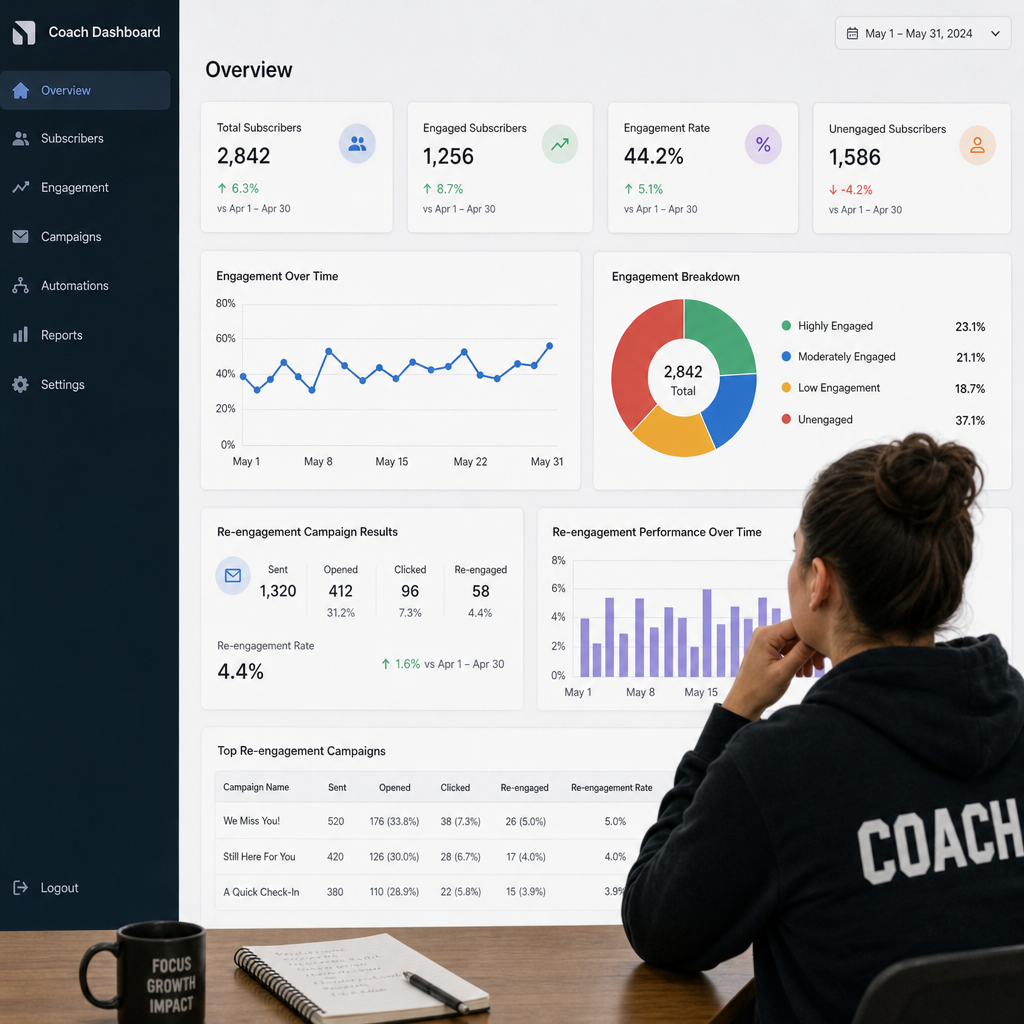
Re-engagement email campaigns for coaches are designed to reconnect with people who have stopped opening, clicking, or replying. Some subscribers are still interested but busy. Others have outgrown the topic. A re-engagement sequence helps you identify who wants to stay and clean up your list without taking silence personally.
These campaigns are especially important because a smaller engaged list is usually more valuable than a large list of people who never interact. Re-engagement also gives you useful feedback. If people click on a topic, answer a question, or choose to stay, you learn what still matters to them.
A simple re-engagement sequence can include:
- The check-in email: Ask if the topic is still relevant and offer a useful resource.
- The choice email: Let subscribers choose what they want to hear about, if your email platform supports preferences.
- The best-of email: Share your most useful articles, podcast episodes, or guides in one place.
- The final confirmation email: Tell them you will remove inactive subscribers unless they click to stay.
Keep the tone human. You do not need to guilt people into staying. A simple message like, “I only want to send emails if they are useful to you,” can be enough.
Subject lines and calls to action make the email easier to act on
Even the best email can underperform if the subject line is vague or the call to action is buried. Subject lines should create curiosity while still matching the content of the email. Calls to action should be specific and easy to follow.
For coaching emails, clear often beats clever. A subject line such as “A question for your next career move” is more useful than something so mysterious that readers do not know why they should open it. Similarly, “Book a consultation” is clearer than “Take the next step” when the next step is a consultation.
Before sending an email, check these basics:
- Does the subject line reflect the actual message?
- Is the email focused on one main idea?
- Is the first paragraph relevant to the reader’s problem?
- Is there one clear call to action?
- Have you linked to the most relevant internal page, such as a service page, article, booking page, or resource?
- Does the email sound like something you would actually say to a client?
These small details make email marketing for coaches more effective because they reduce friction. Your reader should never wonder, “Why am I getting this?” or “What am I supposed to do now?”
A simple coaching email plan to start with
If you are starting from scratch, do not try to build a complicated automation system on day one. Start with a simple plan you can repeat. Once you know what your audience responds to, you can refine your segments, templates, and campaigns.
Here is a practical starter plan:
- Create one lead magnet or clear signup reason. Give people a specific reason to join your list.
- Write a five-email welcome sequence. Introduce your work, teach one useful idea, and include an invitation.
- Send one weekly email. Rotate between education, story, proof, and offer.
- Link to your core pages. Include internal links to your coaching services, booking page, blog posts, and relevant resources.
- Review engagement monthly. Notice which topics get replies, clicks, or bookings.
- Run a re-engagement campaign quarterly or as needed. Give quiet subscribers a chance to reconnect or opt out.
This plan is simple enough to maintain and strategic enough to support growth. Over time, you can add more advanced email marketing coaching tactics, such as segmentation by interest, automated nurture paths, and launch sequences for specific offers.
The best coaching emails feel personal and purposeful
The right emails help your list understand your coaching philosophy, learn from your expertise, and see a clear route to working with you. Start with a welcome sequence, send consistent value, share stories that connect, include proof where appropriate, invite people into your offers, and use re-engagement emails to keep your list healthy.
You do not need to write perfect emails. You need to write useful, honest, focused emails that meet your audience where they are and guide them toward the next helpful step. When you do that consistently, your email list becomes more than an audience. It becomes a community of people who understand your work and know how to take action when the time is right.
If you want to see how we build complete email systems for online coaches, check out our Email Marketing Setup for Coaches service.
Frequently Asked Questions
Quick answers to the most common questions about this topic.
Get welcome sequences, nurture flows, tagging, and automated follow-up built so your email list turns into paying clients on autopilot. done-for-you email marketing system.
Related Articles
How to Build an Email List for Your Coaching Business
Email list building for coaching business growth starts with a clear offer, a simple signup path, and consistent email marketing coaching that turns subscribers into warm prospects.
Email MarketingHow Many Emails Should You Send After Someone Downloads a Lead Magnet?
A good lead magnet email follow-up usually includes five to seven emails sent over about one to two weeks. Learn optimal email marketing tactics for balanced engagement and conversion.
Email MarketingHow to Build an Email Nurture Sequence for Coaching Leads
Discover how to build an email nurture sequence for coaching leads that turns interest into action. Learn to create personalized, effective lead nurturing emails and email drip campaigns to build trust and drive conversions.